





The right digital PR and editorial link agency can really make a difference to how a brand builds authority, earns media attention and boosts its online visibility. But not all agencies operate the same way and choosing one is more than just looking at prices or backlinks.
In this guide, we go over the Top Digital PR and Editorial Link Agencies, including their services, campaign approaches, industry expertise, pricing considerations, and notable strengths, to help you find the right partner for your business goals.
How We Evaluated These Agencies
| Evaluation Factor | What We Assessed |
|---|---|
| Digital PR Expertise | Experience in planning and executing digital PR campaigns that attract media attention and strengthen online visibility. |
| Editorial Link Quality | Relevance, credibility, and editorial standards of publications where backlinks may be earned. |
| Media Outreach | Ability to connect with journalists, editors, publishers, and relevant industry publications. |
| Campaign Creativity | Use of original research, data-driven stories, expert insights, and creative content to generate coverage. |
| Link-Building Strategy | Approach to earning contextual, relevant editorial backlinks through legitimate outreach methods. |
| Industry Specialization | Experience serving specific sectors, such as SaaS, technology, e-commerce, finance, and B2B businesses. |
| Pricing and Value | Availability of pricing information, service scope, campaign options, and potential value relative to cost. |
| Reporting and Transparency | Clarity of campaign updates, placement details, performance reports, and link acquisition practices. |
| Performance Measurement | Methods for tracking earned backlinks, referring domains, media mentions, referral traffic, and campaign outcomes. |
| Business Suitability | How well each agency’s services, expertise, and campaign approach align with different business goals and budgets. |
1.Humanloop
Humanloop is an enterprise platform for LLM development that offers prompt management, evaluations and observability. It allows teams to version prompts, track model outputs, gather human feedback, and manage deployments. Free trial with limited evaluation runs and logging.
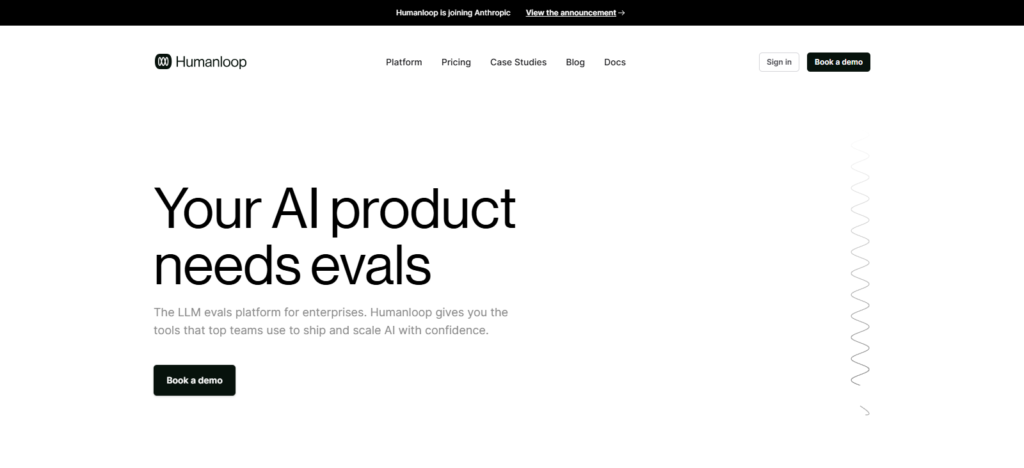
Advanced features such as SSO, VPC deployment, role-based permissions and enterprise support are available as part of custom Enterprise plans. Performance tracking is Online monitoring, tracing, evaluation reports and collection of feedback. Humanloop is often used in legal, customer support, SaaS and enterprise AI applications, where governance and reliability are critical.
Main Processes
- Prompt Management: Manages prompts and version control for AI applications.
- Model Evaluation: Evaluates model responses against defined quality criteria.
- Experimentation: Comparing prompt variations and model outputs.
- Team Collaboration: Assists product and engineering teams in reviewing AI behavior.
- Quality Improvement: Applies evaluation feedback to improve prompts and outputs.
Benefits
- Immediate assessment procedures.
- Bridges the gap between technical and product teams.
- Aids in comparing model responses.
- Provides uniformity in quality assessment.
Cons
- Need to confirm if product is still available.
- Past pricing is not necessarily indicative.
- Technical knowledge may be needed for advanced workflows.
- If the service is not available, migration may be required.
2. Prompt Layer
PromptLayer equips AI engineering teams with tools for prompt management, LLM observability, tracing and evaluation. It enables organizations to track prompt versions, assess outputs, monitor costs, and debug AI workflows. Pricing starts with a Free plan and then Pro ($49/month), Team ($500/month) and Enterprise custom packages.
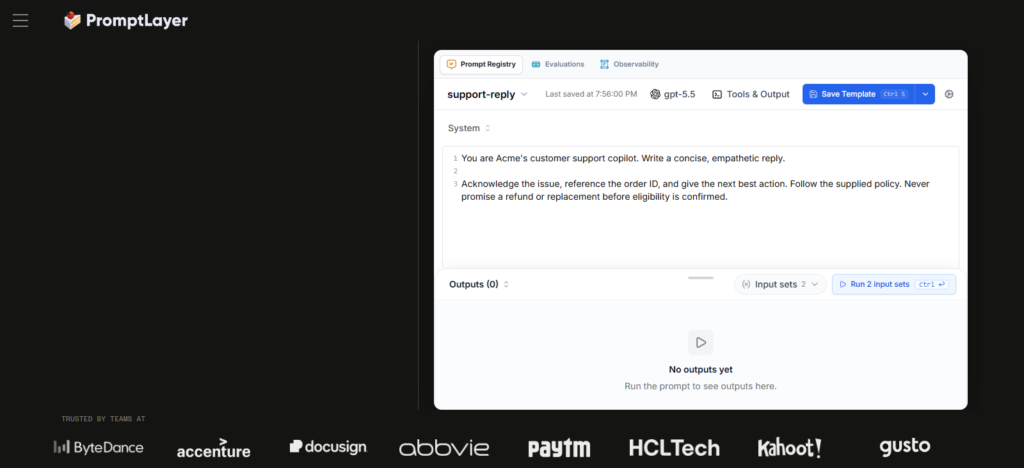
The platform also provides deep performance tracking with request logs, workflow tracing, evaluation dashboards, and latency monitoring. “Transparent reporting helps teams analyze AI behavior and refine prompts. PromptLayer assists SaaS companies, AI startups, customer support platforms, and enterprises building production-grade generative artificial intelligence systems.


Major Processes
- Prompt Management: Organizes, manages, and versions prompts.
- Request Logging – Records LLM requests and responses for review.
- Prompt Testing: Compares changes in prompts and output quality.
- Workflow Monitoring: Enables application behavior and error analysis.
- Team Collaboration: Facilitates collaborative prompt workflows and review.
Advantages
- Centralized versioning of prompts.
- Request histories for easier debuging
- Allows to compare prompt variations.
- Good for collaborative AI development.
Disadvantages
- Costs (based on use) may increase with scale.
- Some features may be exclusive to paid plans.
- Development effort is required for integration.
- Logged data management raises privacy issues.
3. Langfuse
Langfuse is an open-source LLM observability and evaluation platform widely used for monitoring AI applications at scale. It provides fast management, tracing, datasets, evaluations, experimentation and analytics in one environment. Langfuse offers a free self-hosted option and paid plans for production workloads in the cloud.
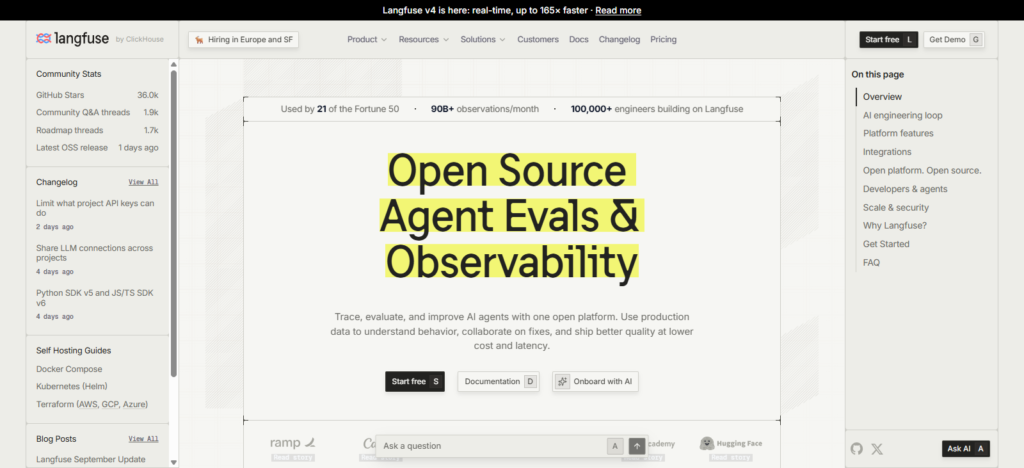
Performance tracking means token usage analysis, latency monitoring, cost tracking, error detection, and quality evaluation. Transparency into AI activity is provided by comprehensive dashboards and alerts. Langfuse is being adopted by startups, enterprises, fintechs and developer teams for scalable open source observability with flexible deployment options.
Main Processes
- LLM Tracing: Traces operations across AI application workflows.
- Prompt Management: Versions prompts and enables controlled updates.
- Evaluation: Uses given criteria and methods of evaluation to rate outputs.
- Cost Monitoring: Keeps track of the tokens used and the costs incurred by the model.
- Performance Analysis: Validates latency, errors and quality of output.
Benefits
- Enables verbose LLM trace.
- Can be self-hosted, open source.
- Merges prompts, evaluations and monitoring.
- Allows for the customization of deployment.
Cons
- Running your own server means dealing with infrastructure.
- In-depth analysis requires technical skills.
- High volumes of tracing can increase operating costs.
• It is complex to configure for beginners.
4. LangSmith
LangSmith is an observability and evaluation platform for AI agents and LLM apps built by LangChain. It provides tracing, monitoring, debugging, testing and deployment support for production artificial intelligence (AI) systems. It has a free Developer plan and paid Plus plans starting at about $39 per seat per month.
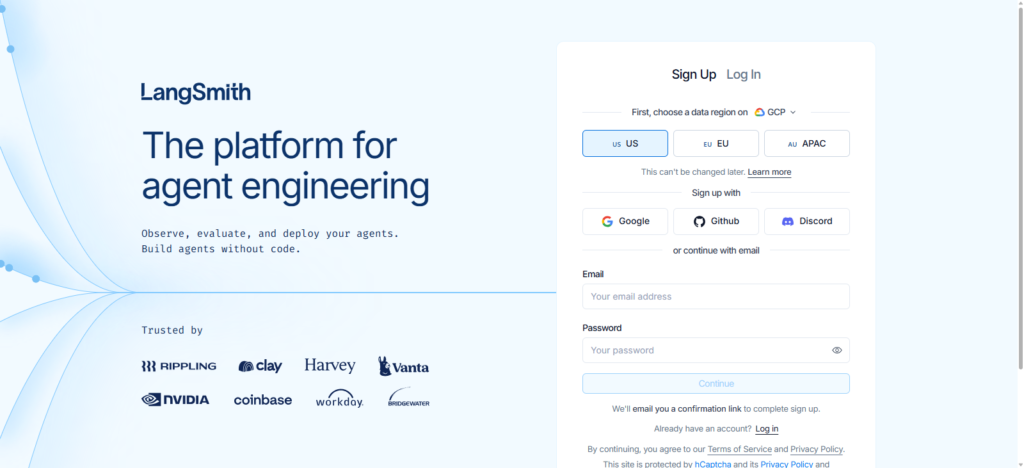
Enterprise pricing is custom. Important features for tracking keys are trace visualization, failure detection, cost monitoring, quality scoring and analysis of agent behavior. Reporting tools help teams identify performance trends and optimize prompts. LangSmith is especially popular among developers building AI agents, RAG systems, and enterprise LLM applications.
Critical Steps
- Application Tracing: Tracks execution steps in LLM workflows.
- Dataset Creation: Creates datasets for repeatable testing.
- Model Evaluation: Compares the quality of the output to the criteria selected.
- Comparison of Experiments: Compares different versions of prompt, model and application.
- Application Monitoring: Tracks app performance and error analysis.
Benefits
- Excellent tracing and debugging features.
- Facilitates systematic evaluation workflows.
- Useful for LLM and agent development.
- Tightly integrated with LangChain and LangGraph.
Cons
- Some features may be available only in a paid plan.
- Interpreting complex traces can be difficult.
- Some technology stacks are more difficult to integrate.
- Usage may increase the costs of monitoring
5. Portkey AI
Portkey AI is an AI gateway and observability platform to manage, monitor and optimize the LLM traffic across multiple providers. It integrates routing, prompt management, tracing, caching and governance in one system. It has a free Developer tier, a Production plan starting around $49 per month and custom Enterprise options.
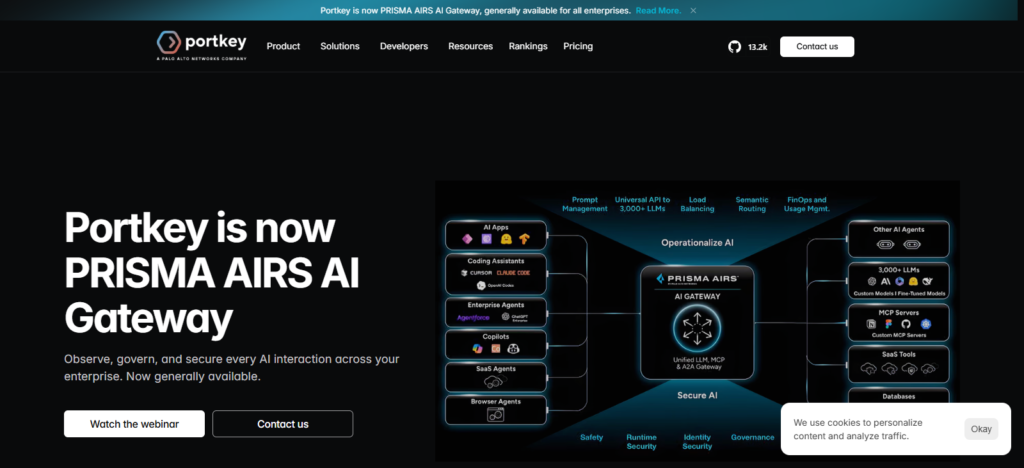
Request latency, token consumption, cost analytics, error monitoring and provider-level insights are all part of performance tracking. Reporting dashboards provide operational transparency and budget control. SaaS companies, AI startups, and enterprises with multi-model AI infrastructure often use Portkey.
Major Processes
- AI Gateway Management: Responsible for routing application requests to supported models.
- Request Routing: routes traffic according to configured rules.
- Reliability Management: Allows retry and fallback settings.
- Observability: Watches for requests, errors, latency, and usage.
- Cost Control: Monitor model usage and maintain spending within limits.
Benefits
- One-stop-shop for multiple model providers.
- Supports configurable fallback and routing.
- Observability at the request level.
- Aids in tracking model usage and cost.
Cons
- You need technical knowledge to set up a gateway.
- Some more advanced features may be plan-dependent.
Extra infrastructure can make architecture complicated. - May still be subject to provider specific limitations
6. Baserun
Baserun is an AI observability, debugging and performance monitoring platform for LLM apps. The platform lets teams inspect prompts, analyze outputs, monitor costs and troubleshoot AI workflows. It offers tracing features that enable developers to find bottlenecks and improve application reliability.
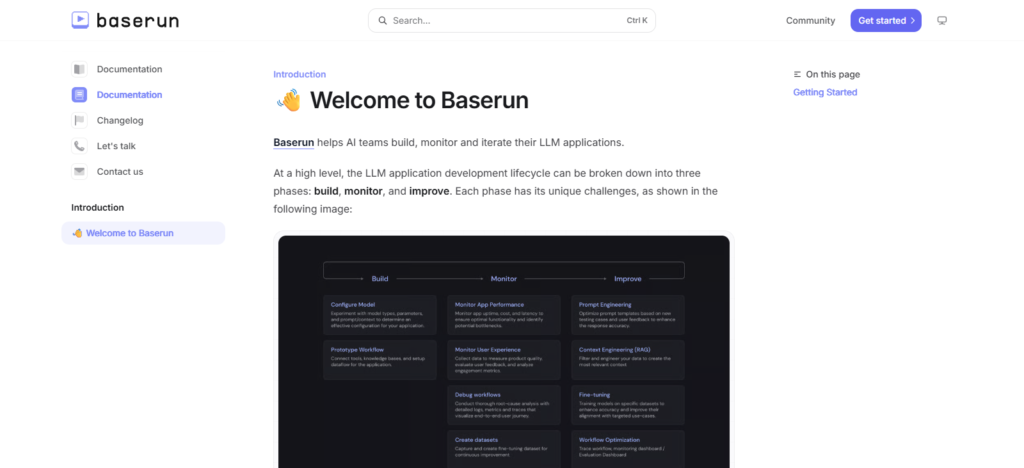
Generally pricing is tiered by usage and is enterprise oriented depending on your deployment requirements. Performance analytics include insights into model behavior, request tracking, latency monitoring, and token usage reporting. Baserun is a great fit for AI startups, engineering teams and product orgs who need visibility into production AI environments and continuous optimization capabilities.
The Main Processes
- Prompt Evaluation: Measures prompts on representative inputs.
- Output Inspection: Checks the generated responses for undesirable output.
- Debugging: Helps to discover problems in LLM apps.
4.Evaluation: Measures output quality against defined expectations. - Regression Testing: Tests whether changes impact previously working behaviors.
4 Pro’s
- Practical testing of LLMs is the focus.
- Assists with output issues.
- Supports structured debugging flows.
- Testing concepts can increase confidence in the release.
Disadvantages 4
- Current product status review
- Pricing and support may be out of date.
- Older integrations may not be supported anymore.
- may need a replacement if unavailable for teams
7. Braintrust
Braintrust is a platform for AI evaluation and prompt testing that focuses on measurement, benchmarking and model quality improvement. It allows teams to create datasets, run evaluations, compare models and measure AI performance over time. It allows developers and AI researchers to collaborate on projects.
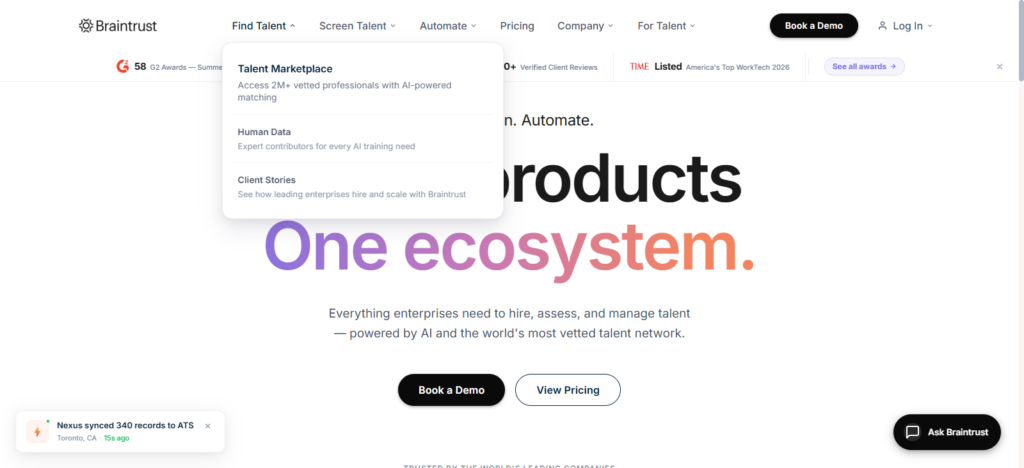
Pricing includes free usage for smaller projects and enterprise deployments with advanced governance and security features. Performance monitoring includes evaluation metrics, experiment tracking, prompt comparisons, and regression testing. Braintrust is used by AI product teams, research groups, and enterprises looking for reliable ways to evaluate model quality before deployment.
Major Processes
- Dataset Management: Enables the curation of examples to support repeatable assessment of AI.
- Scoring: Human or automatic standards to assess responses.
- Experimentation: Compare prompts, models and versions of applications.
- Production Observability: Observes traces and real world application behavior.
- Regression Detection: Identifies quality changes following updates.
Benefits
- Enables repeatable AI assessments.
- Helps to compare model and prompt performance.
- Connects testing and observability.
- Good for collaborative evaluation workflows.
Drawbacks
- Good evaluation if datasets are well designed.
- Some advanced features may cost extra.
- Custom scoring may require some development effort.
- Data governance is essential to production monitoring
8. Weights & Biases – Prompts
Weights & Bias The prompts build on the company’s machine learning experiment tracking capabilities for generative AI development. It lets teams manage prompts, evaluate outputs, compare model versions, and monitor production performance. Pricing generally follows the Weights & Biases subscription model, with free and enterprise options.
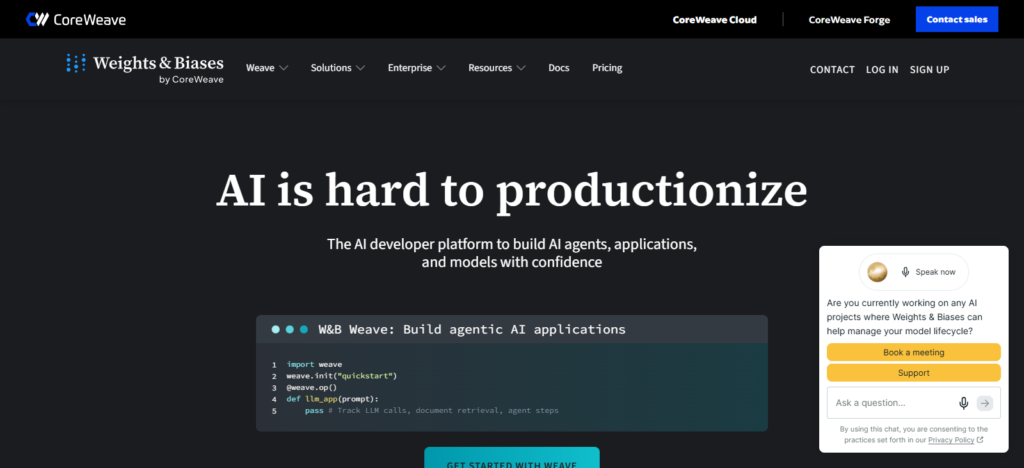
Features include experiment logging, prompt analytics, model comparisons, token analysis and custom evaluation metrics. Reporting dashboards give deep visibility into how artificial intelligence systems behave. It is a platform for AI researchers, machine learning engineers, enterprises and organizations building state of the art products powered by LLMs.
Main Processes
- Experiment Tracking: Logs model and experiment parameters.
- Prompt Iteration – Tests and refines prompts within the framework of experiments.
- LLM Tracing: Scrutinizes application calls and execution paths .
- Assessment: Evaluation of outputs against defined criteria.
- Compare results: Compare experiments to get a feel for the differences in performance.
Benefits
- Good experiment tracking eco-system.
- Supports repeatable development processes.
- Allows for comparison of versions of AI apps.
- Helpful for teams doing ML and LLM experimentation.
Disadvantages
- The product ecosystem can take a little getting used to.
- Certain features may be limited to paid plans only.
- Small team health check complexities.
- Capabilities vary from product to product
9. Phoenix AI Arize
Arize AI Phoenix is an open-source observability framework for monitoring and evaluating LLM and RAG applications. It provides tracing, retrieval analysis, hallucination detection, and performance diagnostics to enhance AI reliability. Arize also provides enterprise-grade commercial solutions separately. Organizations can self-host Phoenix for free.
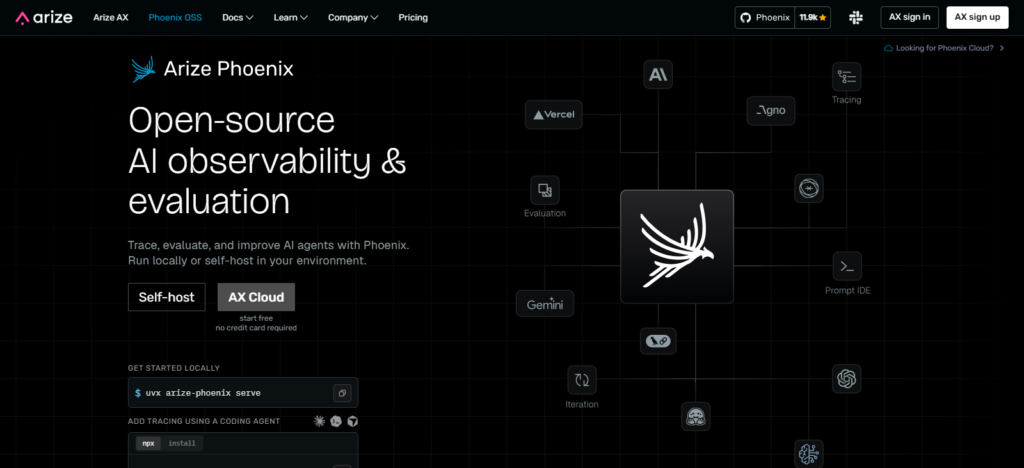
Performance tracking covers embeddings analysis, latency metrics, retrieval quality monitoring, and output evaluation. Reporting features help teams identify model weaknesses & enhance user experiences. Phoenix is popular for AI research, enterprise machine learning, recommendation systems, and organizations running generative AI applications at production scale.
Main Processes
- LLM Tracing: Watches model calls and application runtime.
- RAG Analysis: Looks at retrieval and generation workflow.
- Evaluation: Scores outputs on relevance, correctness, and other criteria.
- Experimentation: Comparison of configurations and results of evaluation.
- Troubleshooting: Investigates quality issues using traces and evaluations.
Benefits
- Observability option, open-source.
- Nice for debugging RAG apps.
- Supports trace and evaluation workflows.
- Self-hosted deployments offer flexibility.
Cons
- You have to manage self-hosted services.
• Technical expertise is needed for complex assessments. - Very high trace volumes may need more resources.
- Results are sensitive to the choice of evaluation criteria
10. Maxim_AI
Maxim AI is an AI observability and evaluation platform to help testing, prompt optimization and quality assurance across the AI development lifecycle. It allows teams to run evaluations, compare prompts, benchmark models and monitor production systems. Prices are usually structured to meet the requirements of the organization and the level of use.

Performance tracking includes automated testing, analysis of experiments, benchmarking of models, monitoring of latency and measurement of quality. Reporting tools give you useful information to make better decisions and deploy with confidence. Maxim AI is primarily targeted at enterprise AI teams, product developers and organizations building mission critical generative AI solutions.
Major Processes
- AI Evaluation – Checks model outputs against quality criteria.
2.Simulation: It checks applications or agents against scenarios. - Experimentation: Compares prompts, models and configurations.
- Observability: Monitors AI application behavior in production.
- Quality optimization: Uses evaluation results to improve reliability
Benefit
- Merges evaluation and observability workflows.
- Enables testing with different scenarios.
- Handy for AI agent development.
- Helps teams find quality issues before and after deployment.
Advantages
- Prices may vary based on usage and enterprise requirements.
- Complex workflows might need technical expertise.
Integration takes time and engineering resources. - Check feature availability for the selected plan.
How to Choose the Best Digital PR Agency?
Define Your Goals Before you select an agency, decide whether you are seeking stronger editorial backlinks, brand awareness, media coverage, referral traffic, or increased organic visibility.
Evaluate Industry Experience: Select an agency that has experience in your industry, with examples of campaigns they have executed and a good understanding of your target audience and the media landscape.
Evaluate Link Quality: Look for agencies that are getting relevant editorial links from trusted publications, not just the domain authority or the number of backlinks they have.
Review Campaign Strategies: Review how agencies create original research, creative narratives, expert insights, and newsworthy content to entice journalists, editors, and respected publishers.
Pricing and Packages: Examine retainers, project fees, deliverables, contract terms and other costs to see if an agency fits your budget and campaign needs.
Evaluate Reporting Transparency: Seek agencies that provide transparent reporting on earned links, media placements, campaign progress, referral traffic, and key performance indicators.
Check Reputation and Results Look for authentic client reviews, relevant case studies, campaign examples, and independently verifiable results rather than promotional claims.
Don’t Buy Unrealistic Guaranties: Avoid agencies that promise rankings or a certain number of high-authority links, and instead focus on ethical outreach, editorial relevance, and sustainable long-term results.
Final Thought
Depending on your AI maturity, scalability, and deployment needs, the right LLM observability and prompt management platform for your organization will vary. Tools like Humanloop, PromptLayer, Langfuse, LangSmith, Portkey AI, Baserun, Braintrust, Weights & Biases Prompts, Arize AI Phoenix and Maxim AI each address important parts of the generative AI life cycle including prompt versioning, tracing, evaluation, monitoring and quality assurance.
Enterprise governance teams might prefer platforms that have better security and compliance features, whereas developer-centric teams might prefer open-source flexibility and a wide range of customization. The best solution, in the end, is one that offers reliable monitoring, useful insights, transparent reporting, and continuous improvement for production AI applications.
Frequently Asked Questions
What Is a Digital PR Agency?
A digital PR agency helps businesses build online visibility and brand credibility through media outreach, newsworthy content, journalist relationships, and earned editorial backlinks from relevant publications.
What Is Editorial Link Building?
Editorial link building involves earning backlinks naturally when publishers, journalists, or editors reference a brand’s content, research, expertise, or resources within their articles.
How Much Do Digital PR Agencies Charge?
Pricing varies depending on campaign complexity, content production, outreach requirements, industry competition, and agency expertise. Some agencies charge monthly retainers, while others offer project-based or customized packages.
How Long Does a Digital PR Campaign Take?
Digital PR campaigns may take several weeks or months to generate meaningful media coverage. Results depend on campaign quality, journalist interest, publication schedules, and industry relevance.