






The cryptocurrency industry is becoming increasingly competitive, making it important for businesses, investors, and blockchain startups to understand what their competitors are doing. From tracking market performance and wallet movements to analyzing DeFi protocols and social engagement, the right research tools can provide valuable insights.
In this article, I will discuss the best crypto competitor analysis tools that help users monitor competing projects, evaluate market trends, compare blockchain performance, and identify new opportunities in the rapidly evolving crypto ecosystem.
How We Evaluated These Best Crypto Competitor Analysis Tools?
We evaluated these crypto competitor analysis tools based on their analytical capabilities, data reliability, blockchain coverage, competitor monitoring features, and overall usefulness for crypto businesses, investors, and research teams.
| Evaluation Criteria | What We Considered |
|---|---|
| Data Accuracy | Reliability, consistency, and freshness of cryptocurrency market and blockchain data. |
| Competitor Tracking | Ability to monitor competing crypto projects, compare performance, and identify market positioning. |
| On-Chain Analytics | Availability of wallet tracking, transaction monitoring, whale activity, and token flow analysis. |
| Market Intelligence | Coverage of token prices, market capitalization, trading volume, and historical market trends. |
| DeFi Analytics | Availability of TVL, protocol fees, revenue, liquidity, and DeFi performance metrics. |
| Social Sentiment Analysis | Ability to monitor social engagement, community growth, sentiment, and influencer activity. |
| Blockchain Coverage | Number and variety of supported blockchain networks, protocols, and crypto ecosystems. |
| Reporting and Dashboards | Custom dashboards, data visualization, historical comparisons, and reporting capabilities. |
| Pricing and Accessibility | Free features, subscription plans, pricing flexibility, and accessibility of advanced analytics. |
| Ease of Use | Interface usability, navigation, learning requirements, and suitability for different experience levels. |
Quick Comparison Table
| Tool Name | Best For | Key Competitor Analysis Features |
|---|---|---|
| Messari | Crypto project research | Project profiles, research reports, token metrics, sector analysis, fundraising data |
| Nansen | Competitor wallet analysis | Smart Money tracking, wallet labels, token flows, address monitoring |
| Dune Analytics | Custom blockchain analysis | SQL queries, protocol dashboards, transaction data, on-chain comparisons |
| DeFiLlama | DeFi competitor benchmarking | TVL comparisons, protocol fees, revenue, yields, chain rankings |
| Token Terminal | Protocol financial comparisons | Revenue, fees, active users, financial metrics, valuation comparisons |
| Artemis | Blockchain ecosystem benchmarking | Network activity, transaction metrics, active addresses, chain comparisons |
| Santiment | On-chain and social monitoring | Social sentiment, development activity, whale activity, network metrics |
| LunarCrush | Social competitor analysis | Social engagement, community activity, influencer metrics, sentiment tracking |
| Arkham Intelligence | Competitor wallet intelligence | Entity tracking, wallet attribution, transaction monitoring, fund-flow analysis |
| CoinGecko | Crypto market comparison | Token prices, market capitalization, trading volume, exchange and category data |
1.Messari
Messari is a crypto research and market intelligence platform that provides institutional style reports, asset profiles, protocol metrics, governance tracking, screeners, fundraising data, and AI assisted research tools. Its on-chain analytics includes activity, token flows and protocol fundamentals across 50+ networks.
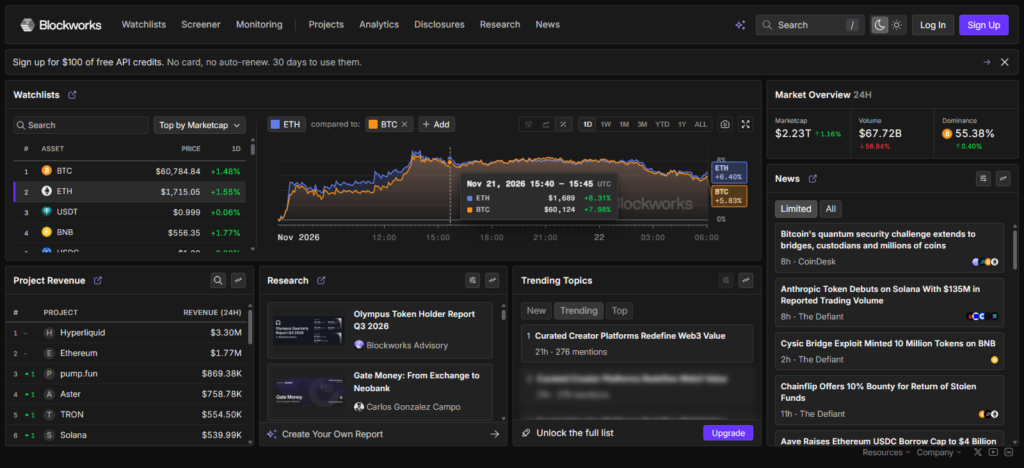
Its market intelligence is long-term due diligence, not quick trading signals. DeFi analytics: Usage of protocols, fees & revenue, ecosystem comparisons. We cover blockchain on the major networks including Ethereum, Solana, Bitcoin and many L2s.
Dashboards and reporting offer curated research, alerts, screeners and custom enterprise data access. Pricing has ranged from limited free access to Pro subscriptions at about $29.99–$375 monthly depending on access level, to custom enterprise plans.
Procedure
- Choose the crypto project or token you wish to investigate.
- Review project profiles, tokenomics & fundamentals.
- Analyze the market performance and the available financial metrics.
- Use research reports and sector data to compare competing projects.
- Assess project positioning, fundraising activity and ecosystem developments.
Pros
- Offers comprehensive crypto project research and market intelligence.
- Provides token metrics and fundamental analysis.
- Simplifies comparing different blockchain projects and industry sectors.
- Contains research reports and insights on the ecosystem.
Disadvantages
- advanced research features are only available on subscription
- Some of the information might be difficult for the beginner to understand.
- Data coverage varies between cryptocurrency projects.
- Not as focused on actual real-time wallet tracking.
2. Nansen
Nansen is an on-chain intelligence platform recognized for its wallet labeling, entity attribution, and “Smart Money” tracking. It assists users to analyze wallet behavior, token flows, DeFi positions, NFT activity and counterparties via labeled addresses and interactive dashboards. Its market intelligence stems from tracking influential wallets, funds, exchanges and early movers, not traditional fundamental research.
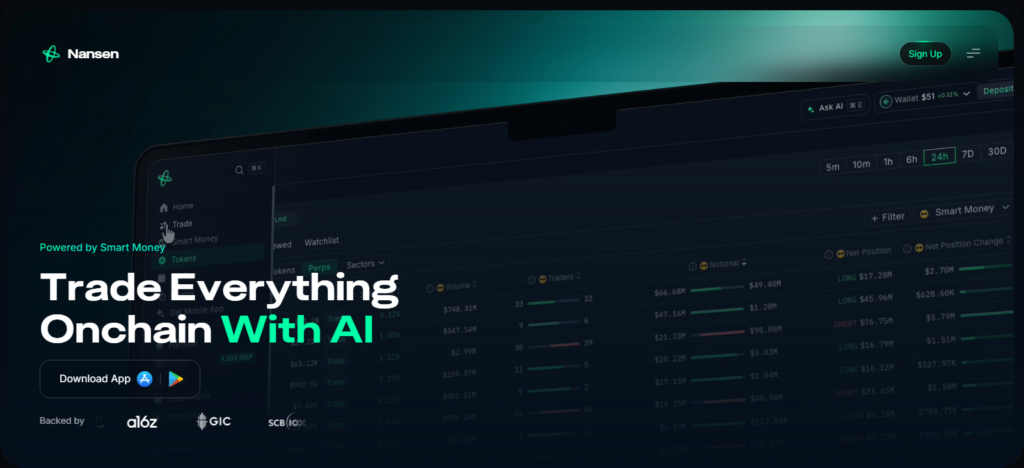
DeFi analytics provide insights into protocol activity, portfolio, yield, lending, liquidity & more. Nansen supports over 25 blockchains including Ethereum, Solana, BNB Chain, Base, Arbitrum and Polygon. Dashboards and reporting assist with wallet profiling, watchlists, alerts and customizable queries. It has a free tier in its pricing, and the Pro access is said to cost around $49- $69 per month, with enterprise options for teams.
The process
- Choose the blockchain network or crypto project.
- Search for the relevant wallets using wallet labels and entity information.
- Track the moves of Smart Money and notable investors.
- Review token transfers, wallet balances, and transactional behavior.
- Analyze the activity of your competitors to identify capital flows and market trends.
Advantages
- Delivers detailed wallet intelligence and address labeling.
- Tracks Smart Money movements on supported networks.
- Allows to track token flow and transactions.
- Helps in understanding of investor behavior and competitor holdings.
Disadvantages
- Advanced analytics may require a paid subscription
- Wallet attribution is not 100% all the time.
- It has a complex interface and metrics for newbies.
- Features have different blockchain coverage.
3. Dune Analytics
Dune Analytics is a community-driven blockchain analytics platform powered by SQL, enabling analysts to query decoded on-chain data and publish reusable dashboards. Its core strength is custom on-chain analytics. Users can write SQL queries, build charts, and analyze protocol usage, transactions, users, liquidity and token flows.
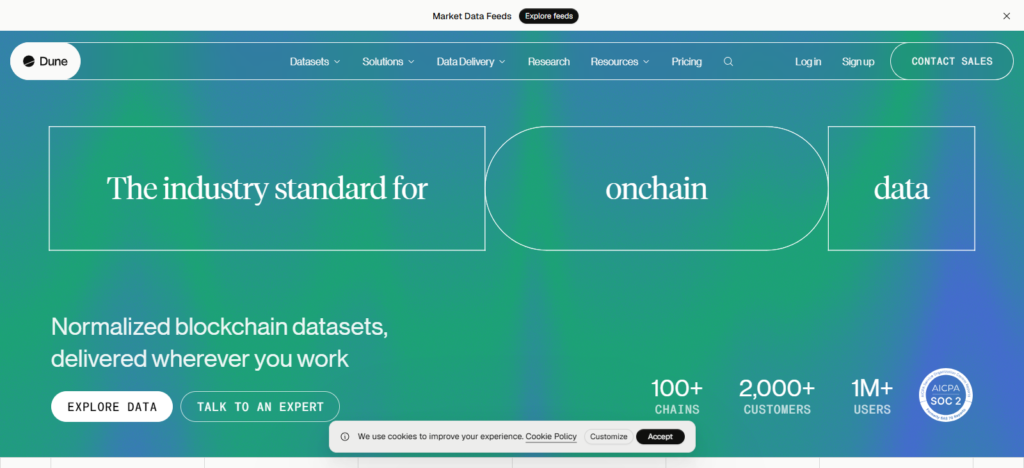
Market intelligence is generated through community dashboards, trend tracking and bespoke research rather than a proprietary research desk. DeFi analytics is wide, from DEX volumes to lending markets to stablecoins to bridges to protocol revenues.
Dune supports 100+ chains including Ethereum, Solana, Polygon, Arbitrum, Base and Optimism. The dashboards and reporting are very flexible and include public, private and embeddable visualizations. Price: Free view-only tier, Analyst around $75 a month, Plus around $399 a month and custom enterprise plans.
Procedure
- Choose the blockchain ecosystem or protocol to analyze.
- Identify relevant data sets and existing community dashboards.
- Write SQL queries to pull data from the blockchain.
- Create custom dashboards to compare competitor performance.
- Keep an eye on historical deals, user activity, and protocol growth.
Advantages
- Highly customizable blockchain analytics supported.
- Lets you explore data using SQL.
- Provides dashboards for comparing performance with competitors.
- Helps with analysis of historical on-chain activity.
Cons
- Advanced analysis requires knowledge of SQL.
- Complex queries can take a long time to build.
- Results depend on the accuracy of queries and availability of data.
- Some paid plans for higher level use.
4. DeFiLlama
DeFiLlama is a free, open-source DeFi data aggregator focused on transparent chain and protocol level metrics. Its tool overview includes total value locked (TVL), yields, stablecoins, bridges, fees, revenue, liquidations, and protocol comparisons. On-chain analytics are aggregate metrics and not raw wallet-level investigation and are thus useful for tracking capital flows and ecosystem growth.
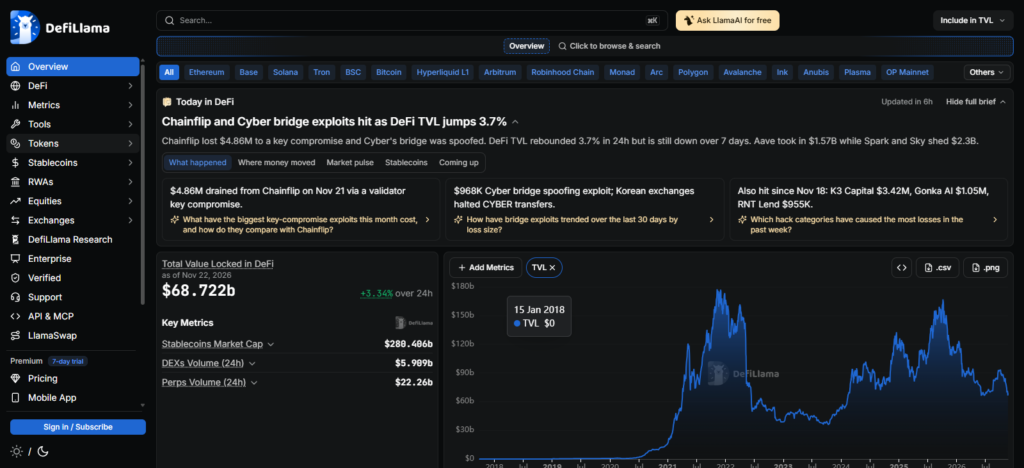
Market intelligence features rankings of chains, protocols, categories, and yield opportunities. Strong suit is DeFi analytics, encompassing lending, DEXs, restaking, liquid staking, bridges, and yield farms. It covers 350+ chains and has an extremely wide coverage of the blockchain. Dashboards and reporting are easy but effective, with sortable tables, charts and a free API. Pricing Free access & $49/month or $490/year for Pro.
Process
- Select the DeFi category, blockchain or protocol.
- Look at the total value locked in competing protocols.
- Compare fees, revenue, liquidity and yield metrics available.
- Review historical performance and ecosystem growth.
- Identify competitors with better adoption and financial activity.
Advantages
- Offers extensive DeFi protocol benchmarking
- Track TVL across various blockchain networks.
- Provides protocol fees and revenue metrics
- Historical data available for performance comparison.
Disadvantages
- It focuses largely on decentralized finance.
- Some of the metrics depend on the protocol data available.
- The definition of project finances can vary.
- Limited wallet attribution compared to specialized tools.
5. Token Terminal.
Token Terminal is a fundamentals-focused crypto data terminal. The company brings equity-style financial analysis to blockchain protocols. Its overview covers standardized metrics like fees, revenue, earnings, treasury holdings, token emissions, user activity and valuation multiples. On-chain analytics look at protocol-level usage and cash-flow data, not individual wallets.
The analysis of comparable company style provides market intelligence that helps users determine whether a protocol is expensive or cheap relative to its peers. DeFi analytics covers DEX, lending, liquid staking, infrastructure, and app revenue data.
We cover around 50 protocols and big networks in the blockchain space – it’s more curated than comprehensive coverage. Dashboards & Reporting Financial statements, charts, screeners, API access. The price includes a free tier, Pro access for about $199-$350 per month and custom API plans.
Methodology
- Choose the blockchain protocol or application.
- Examine available financial and operational metrics.
- Review protocol revenue, fees and earnings.
- Compare financial performance and valuation against competitors.
- Analyze the historical growth and the overall protocol fundamentals.
Pros
- Provides crypto protocols financial analytics.
- Monitors revenue and fee measures.
- Permits basic competitor comparisons.
- Provides historical financial results.
Disadvantages
- Heterogeneous coverage in blockchain applications.
- Certain projects do not have available financial metrics.
- Accounting differences make comparisons difficult.
- Some advanced features may require paid access.
6. Artemis
Artemis is an institutional-grade crypto data and research platform that specializes in comparing blockchain networks and protocols using standardized metrics. It includes an overview of developer activity, active addresses, transaction activity, fees, stablecoin supply, DEX volumes, users and application revenue.
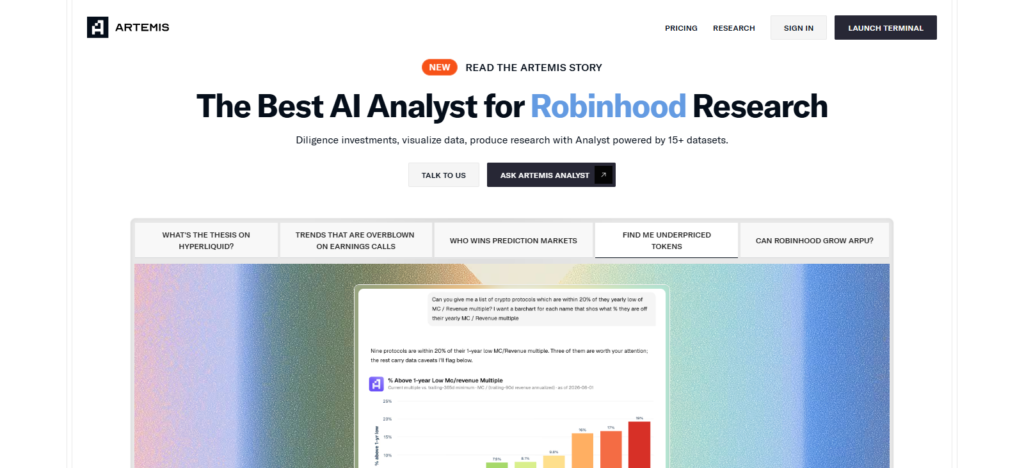
On-chain analysis gives insights into fundamentals of the network itself, and comparisons between chains can help investors gage ecosystem adoption and economic activity. Market intelligence is delivered via curated dashboards, research reports and protocol revenue analysis. DeFi analytics covers trading volumes, users, fees and app-level performance in leading ecosystems.
Artemis tracks ~75 chains including major L1s and L2s. High quality, normalized data is used. Dashboards and reporting are slick and professional investor-friendly, with charts exportable and an API available. Cost: Free access, about $100/month for Investor and custom for Managing Director or enterprise.
Procedure
- Select the blockchain network or ecosystem.
- Check active addresses & transaction activity.
- Analyze the network consumption of rival blockchains.
- Study developer activity, and ecosystem growth.
- Assess adoption trends and network performance in general.
Benefits
- Offers blockchain ecosystem benchmarking.
- Monitors network activity and live addresses.
- Allows to compare different blockchains.
- Provides analytics for developers and adoption.
Drawbacks
- Less emphasis on social sentiment analysis.
- Some metrics require technical interpretation.
- Data availability differs by network
- Not too specialized in wallet level intelligence.
7. Santiment
Santiment combines on-chain, social and development data to measure sentiment and behavioral trends in the crypto market. The tool overview includes social volume tracking, sentiment analysis, whale activity, exchange flows, token age and developer activity. On-chain analytics are more about the behavior of holders, how they transact, how the supply moves, and the activity in the network, rather than deep wallet attribution.
Market intelligence is especially useful for spotting crowd positioning, fear or greed, unusual social spikes, and the potential for divergence between price and sentiment. DeFi analytics are more limited, but include protocol and token activity metrics.
We have a wide blockchain coverage with major assets and networks but not as wide as DeFiLlama or Dune. Dashboards and reporting are customizable with charts, watchlists, alerts, and API access. There’s no charge for access, about $49 a month for Pro and about $249 a month for Max.
Process
- Choose the cryptocurrency or blockchain project.
- Consider on-chain activity and network metrics.
- Whale transaction and investor behavior tracking.
- Check social sentiment and development activity.
- Compare competition on market attention and blockchain performance.
Benefits
- Combines social and on-chain analytics
- Tracks network behavior and whale activity.
- Gives you sentiment indicators about cryptocurrency.
- Monitors development activity on supported projects.
Disadvantages
- Advanced metrics may be challenging for beginners.
- Some features are only available for paid subscribers.
- Social sentiment can be influenced by market noise.
- Metrics availability differs between crypto assets.
8. LunarCrush
LunarCrush is the social intelligence platform that measures crypto market attention through social media activity, engagement, influencers and community sentiment. Its overview focuses on social volume, social dominance, engagement, sentiment, galaxy score, and creator activity on platforms like X, Reddit, and other social channels. Limited on-chain analytics. The platform is mainly social and not blockchain-native.
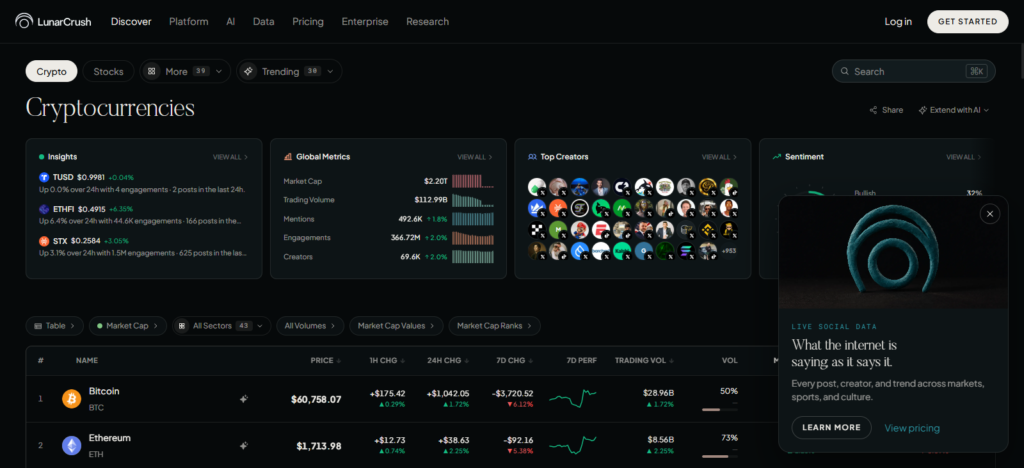
Market intelligence allows users to identify trending narratives, growing communities, influencer attention and potential retail interest before it shows up in price action. DeFi analytics are still barebones, focusing on token-level social performance instead of protocol fundamentals.
Blockchains are extensively covered at the asset level, including thousands of tokens. Dashboards & reporting Rank, watch lists, trend charts, alerts, API access. Paid plans are said to start at $29.99 a month, with limited free access.
Process
- Choose the cryptocurrency project or token.
- Analyze social mentions and audience engagement.
- Look at community activity and sentiment metrics.
- Compare social visibility of competing projects.
- Assessing the influencer activity and changes in market attention.
Pros
- Focused on social analytics for cryptocurrencies.
- Monitors social and community engagement.
- Helps to compare competitor’s brand visibility.
- Provides influencer and sentiment related insights.
Disadvantages
- Some features may require a paid subscription.
- Participation in social activities does not mean project adoption.
- Market hype can influence sentiment data.
- Limited analysis on finances and protocol level.
9. Arkham Intelligence
Arkham Intelligence is a blockchain-intelligence platform that focuses on the discovery of real-world entities behind crypto wallets and tracking their on-chain behavior. It has entity labeling, wallet profiling, transaction tracing, portfolio analysis and counterparty mapping. On-chain analytics are a core strength, you can follow whales, funds, exchanges, bridges and known institutions through transfers and holdings.
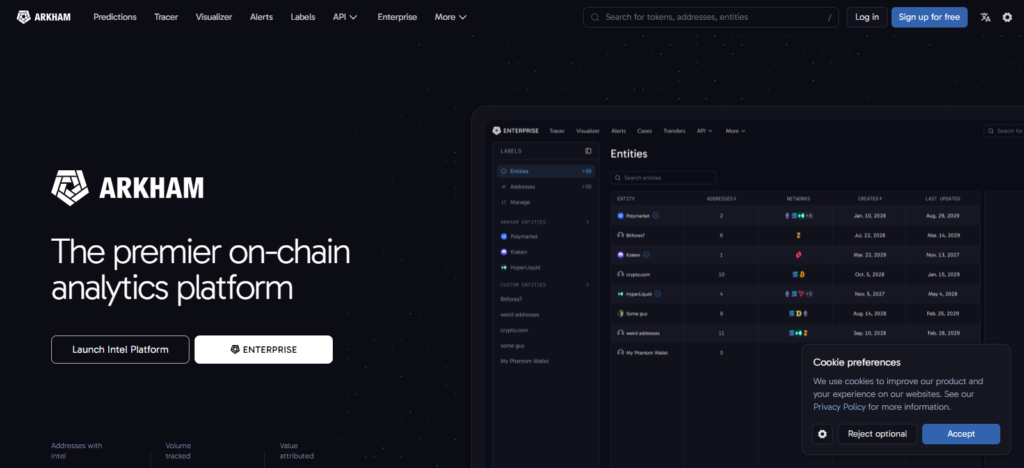
Smart money positioning, large transfers, entity level behavior all give us market intelligence. DeFi analytics include DeFi portfolio tracking, token flows and protocol interaction analysis. Blockchains covered include Ethereum, Bitcoin, Solana, Base, Arbitrum, Tron and other major networks. Entity profiles, visualized flows, watchlists and research tools are available in dashboards and reporting. The core platform is free, and Arkham also has an Intel Exchange where users can request or offer intelligence bounties.
Procedures**
- Choose the blockchain network or related entity.
- Look up identified blockchain addresses and wallets.
- Check transaction history and wallet balance.
- Follow the money between identified entities.
- Compare competitors’ wallet activity and transaction patterns.
Advantages
- Gives you blockchain entity and wallet information.
- Tracks the movement of funds and transactions.
- Provides visual tools to investigate transactions.
- Helps to analyze competitor holdings and wallet movements.
Cons
- Not all wallets may be covered by entity attribution.
- Advanced investigations require blockchain knowledge.
- Network coverage varies by feature.
- No social media and community analytics.
10. CoinGecko
CoinGecko is a comprehensive platform for cryptocurrency market data that provides information on price, trading volume, market cap, liquidity, exchange data, developer activity, community metrics, and token data.
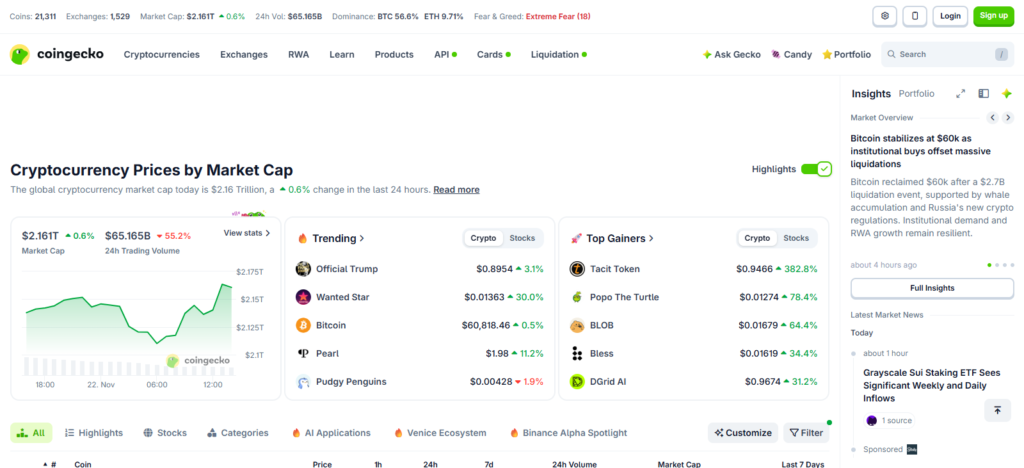
It is broad in scope rather than specialized. It is useful for asset discovery, market comparison and portfolio performance monitoring. Offers select network and exchange data but on-chain analytics are limited compared to Dune, Nansen or Arkham. Market intelligence consists of rankings, trending tokens, gainers and losers, trading volume analysis, and exchange reliability metrics.
DeFi analytics are yield data, DEX tracking and some protocol information but it is not a deep DeFi research terminal. Blockchain has very broad coverage. There are thousands of tokens and hundreds of exchanges. Dashboards & reporting includes watchlists, portfolio tools, charts and a popular API. The site is free, and API plans start around $35 a month and go up from there, depending on usage
Process
- Research the crypto or competitor token.
- Look at market cap and current token prices.
- Compare trading activity and volumes.
- Examine historical price movement and market trends.
- Compare cryptocurrencies by market data and sector classifications.
Benefits
- Provides lots of information on the cryptocurrency market.
- Monitors token price and market cap
- Trading volume and exchange comparison.
- Allows for research on historical market performance.
Disadvantages
- Offers advanced wallet intelligence basics.
- Less protocol financial analysis than dedicated platforms
- Market data coverage varies by asset and exchange.
- It’s not the same as Dune Analytics in terms of custom querying capabilities.
How to Choose the Best Crypto Competitor Analysis Tools?
Data Accuracy and Reliability: Choose tools that provide accurate, regularly updated cryptocurrency data, including token prices, trading volumes, wallet activity, protocol revenue, and blockchain performance metrics.
Blockchain Network Coverage: Evaluate the number of supported blockchain networks, including Ethereum, Solana, BNB Chain, and other relevant ecosystems, to compare competitors across different crypto markets.
On-Chain Analytics: Look for wallet tracking, transaction monitoring, whale movements, active addresses, and token flows to understand competitor activities and blockchain adoption.
Market and Financial Metrics: Prioritize platforms offering market capitalization, trading volume, TVL, protocol fees, revenue, and valuation metrics for meaningful competitor benchmarking.
Social Sentiment Analysis: Select tools that monitor social mentions, community engagement, audience growth, sentiment, and influencer activity to evaluate competitors’ market visibility.
Dashboard and Reporting: Consider platforms with customizable dashboards, historical comparisons, data visualization, and exportable reports to simplify competitor research and performance monitoring.
Pricing and Scalability: Compare free features, subscription costs, usage limits, and premium analytics to ensure the platform fits your research budget and growing business requirements.
Ease of Use and Integrations: Choose user-friendly platforms with accessible analytics, API availability, data integrations, and suitable technical capabilities to support efficient research workflows.
Conclusion
Choosing the right crypto competitor analysis tools enables businesses, investors, and blockchain researchers to understand market trends, evaluate competing projects, and identify growth opportunities. Platforms like Messari, Nansen, Dune Analytics, DeFiLlama, and Token Terminal offer a wealth of information about project performance, wallet activity, protocol revenue, and blockchain adoption, to name a few. Meanwhile, Santiment and LunarCrush help to keep an eye on social sentiment and community engagement.
When picking a platform, think about the accuracy of the data, the blockchain coverage, the analytics, the pricing, and the reporting options. The right mix of tools can strengthen competitive research, improve strategic decision-making and help crypto businesses stay ahead in the ever-changing blockchain industry.
FAQ
What Are Crypto Competitor Analysis Tools?
Crypto competitor analysis tools are platforms that help businesses, investors, and researchers monitor competing cryptocurrency projects, compare market performance, analyze blockchain activity, and identify industry trends.
Which Are the Best Crypto Competitor Analysis Tools?
Some of the best options include Messari, Nansen, Dune Analytics, DeFiLlama, Token Terminal, Artemis, Santiment, LunarCrush, Arkham Intelligence, and CoinGecko.
How Do Crypto Competitor Analysis Tools Work?
These tools collect and analyze cryptocurrency market data, blockchain transactions, wallet activity, protocol metrics, and social engagement to help users compare competing projects.
Which Crypto Competitor Analysis Tool Is Best for DeFi Projects?
DeFiLlama is particularly useful for DeFi competitor analysis because it tracks total value locked, protocol fees, revenue, liquidity, and blockchain ecosystem performance.
Which Tool Is Best for Tracking Crypto Wallet Activity?
Nansen and Arkham Intelligence are useful for wallet intelligence, transaction monitoring, entity identification, and tracking investor fund movements.