




In this article, we will be discussing the Best Blockchain Website Indexing Tools which helps developers to collect, organize and retrieve blockchain data efficiently. These tools facilitate access to transaction histories, smart contract events, wallet activities, and on-chain information across various blockchain networks. Whether you are building decentralized applications, managing DeFi platforms or analyzing Web3 data, the right indexing tool can improve data accessibility, application performance and development efficiency.
How We Evaluated These Best Blockchain Website Indexing Tools?
We evaluated these blockchain indexing tools based on their technical capabilities, data accessibility, developer support, and overall usefulness for Web3 applications.
| Evaluation Criteria | What We Evaluated | Importance |
|---|---|---|
| Blockchain Network Support | Supported networks, multichain compatibility, and ecosystem coverage. | Access to different blockchain ecosystems. |
| Indexing Performance | Data processing speed, synchronization, and query performance. | Faster blockchain data retrieval. |
| Data Coverage | Availability of transaction, wallet, token, NFT, and smart contract data. | Comprehensive on-chain information. |
| API and Query Support | GraphQL, REST APIs, SQL, and data retrieval options. | Easier application integration. |
| Historical Data Access | Availability of past transactions, blocks, and contract events. | Effective blockchain research and analysis. |
| Real-Time Indexing | Live data streaming and blockchain event synchronization. | Updated application information. |
| Customization and Integration | Custom indexing, SDKs, filtering, and developer integrations. | Flexible development workflows. |
| Pricing and Scalability | Free plans, paid options, usage limits, and infrastructure scalability. | Long-term project affordability. |
| Reliability and Accuracy | Data consistency, indexing reliability, and query stability. | Dependable blockchain information. |
| Developer Experience | Documentation, setup complexity, available tools, and technical support. | Easier implementation and maintenance. |
Quick Comparison Table
| Blockchain Indexing Tool | Core Function | Key Features | Best For |
|---|---|---|---|
| The Graph | Decentralized blockchain data indexing | Subgraphs, GraphQL APIs, decentralized indexing | dApps and DeFi applications |
| Subsquid (SQD) | Multichain blockchain data indexing | Historical data extraction, TypeScript SDK, APIs | Multichain Web3 projects |
| Goldsky | Managed blockchain data indexing | Hosted subgraphs, real-time data streaming, data pipelines | Real-time blockchain applications |
| Envio (HyperIndex) | High-performance blockchain indexing | HyperIndex, HyperSync, GraphQL APIs | Fast EVM data indexing |
| SubQuery | Decentralized multichain indexing | Indexer SDK, APIs, custom data processing | Cross-chain applications |
| Covalent (GoldRush) | Unified blockchain data API | Wallet data, transaction history, multichain APIs | Wallets and analytics platforms |
| Bitquery | Blockchain data indexing and analytics | GraphQL APIs, DEX data, token transfers | Blockchain analytics and monitoring |
| Dune Analytics | On-chain data querying and analytics | SQL queries, dashboards, blockchain datasets | Web3 research and analytics |
| Space and Time | Decentralized blockchain data warehousing | Indexed datasets, SQL queries, Proof of SQL | Verifiable blockchain analytics |
| Moralis | Blockchain data APIs and indexing | NFT APIs, token APIs, wallet APIs | Web3 application development |
1. The Graph
The Graph is a decentralized indexing protocol that transforms smart contract events into queryable Subgraphs served over GraphQL APIs. Supports 60+ networks including Ethereum, Solana, Arbitrum, Base, Polygon, Optimism, BNB Chain and zkSync Era. Substreams for real-time & historical streaming. Indexing speed depends on the indexer, the chain and complexity of the subgraph.
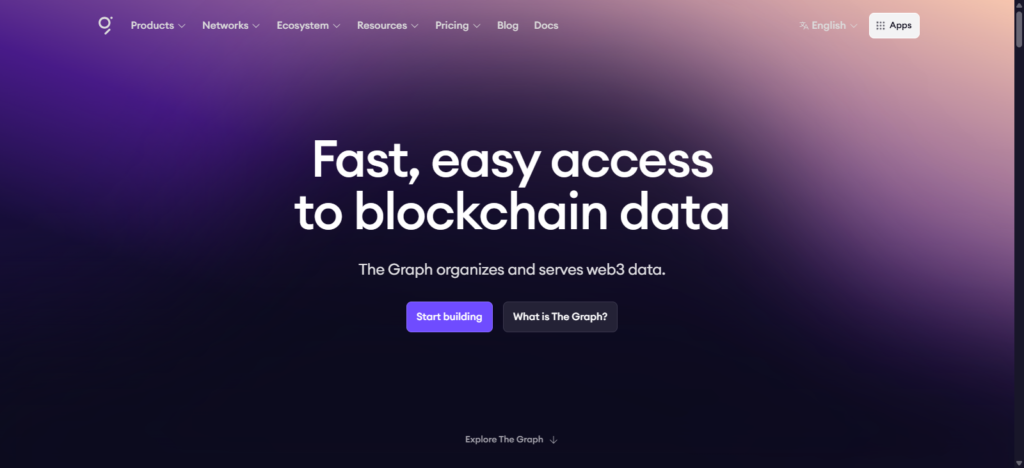
Hosted Subgraph Studio and decentralized Indexers handle syncing and serving. They define entities and mappings and then query via GraphQL. Substreams let you create your own data pipelines. It integrates nicely with SDKs and gateways and has a pricing model that includes a free tier, usage-based query pricing and GRT-based network payments.
Processes**
- Indexes blockchain data via customizable subgraphs.
- Applications GraphQL APIs to access indexed blockchain data.
- Processes events from transaction records and intelligent contracts.
- Enables decentralized indexing by network participants.
- Lets developers to query structured on-chain data for dApps.
Advantages
- Support for multi blockchain network.
- Offers flexible GraphQL query.
- Provides decentralized indexing infrastructure.
- Makes blockchain data accessible to developers.
Cons
- Needs technical knowledge for setting up subgraphs.
- Complex queries might need to be optimized.
- Indexing performance varies with the network and configuration.
- Certain advanced features come at extra cost.
2. Subsquid (SQD)
Subsquid (now known as SQD) is a decentralized data layer and indexing framework for building custom APIs out of raw blockchain data. It supports 225+ networks including EVM chains, Solana, Substrate and Bitcoin, and indexes the entire history of data into typed tables like blocks, transactions, logs, traces and state diffs.
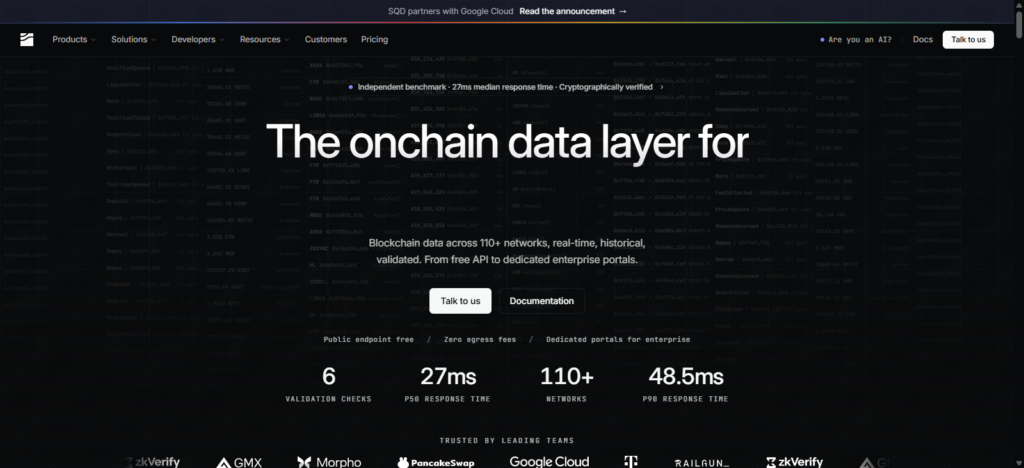
Its Portal provides a public endpoint sufficient for prototyping, and developers are able to create squid indexers in TypeScript and expose GraphQL or SQL interfaces.
SQD’s ingestion pipeline cryptographically validates blocks, enabling reliable historical analytics. Pricing is based on compute units with free daily usage and paid Pro, Business and Enterprise tiers. It is suitable for data-heavy, multichain and custom schema applications.
Basic Processes
- Pulls blockchain data using a scalable indexing infrastructure.
- Processes historical transaction and smart contract events.
- TypeScript support for custom data transformations.
- Provides APIs to retrieve indexed blockchain data.
- Enables developers to create multichain data applications.
Pros
- Supports all historical data on the blockchain.
- Provides customizable indexing.
- Includes developer-friendly TypeScript tools.
- Handles scalable data processing.
Downsides
- Needs development knowledge for customizations.
- Getting it set up initially can be tricky.
- Technical resources may be needed to manage infrastructure.
Complex workloads can lead to higher operating costs.
3. Goldsky_
Goldsky is a managed Web3 data platform with Subgraphs, real-time streaming, RPC and data delivery pipelines. It supports 150+ networks and 271 network endpoints in the EVM, Solana, Bitcoin and Move ecosystems.
Its Subgraphs are backward compatible with The Graph, have a WASM processing layer and sub second indexing latency, webhooks, custom EVM-chain support and an autoscaled GraphQL query layer.
Goldsky Turbo streams decoded blockchain data into Postgres, ClickHouse or Kafka with sub-second latency, making it strong for real-time dashboards, and event-driven apps. You pay based on worker hours and stored entities, not on query volume. $100 free credit.
Main Processes
- Indexes blockchain events with managed data pipelines.
- Provides hosted subgraphs for blockchain apps.
- Pushes real-time blockchain data to external systems.
- Handles events and transaction details of smart contract transactions.
- Data synchronization for analytics and dApps.
Advantages
- Makes it easier to index managed blockchain.
- Live data streaming support.
- Provides a strong data pipeline infrastructure.
- Reduces management of indexing infrastructure.
Disadvantages
- For advanced pipelines, a technical setup may be required.
- Usage based pricing might increase with demand.
- Customization depends on integrations it supports.
- Some features are only available on paid plans.
4. Send (Hyperindex)
Envio HyperIndex is a high performance multichain indexing framework that turns on-chain events into structured databases and GraphQL APIs. It natively indexes EVM compatible chains, and supports Solana and Fuel. Its HyperSync engine delivers blockchain data at a far faster rate than traditional RPC-based approaches, with historical backfills over 100,000 events per second.
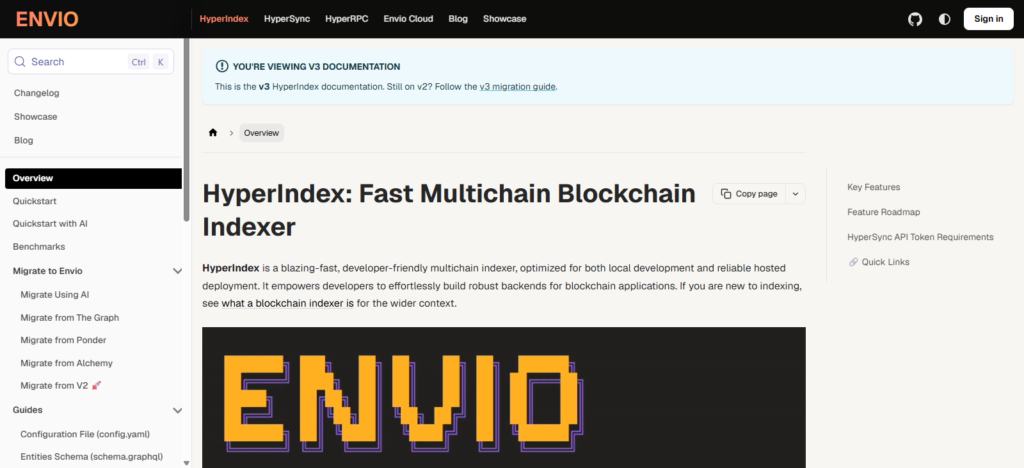
HyperIndex supports multichain indexing in time-ordered or unordered mode, so that a single indexer can combine data from networks like Ethereum and Base. Write TypeScript handlers and query through GraphQL. Hosted plans get direct SQL access. Envio provides a free development plan and production hosting is priced with base plans plus indexing hours. HyperSync also has a free API tier.
Processes Key
- Indexes smart contract events from supported blockchains.
- Uses HyperIndex for blockchain data indexing, configurable.
- Uses HyperSync infrastructure to obtain blockchain info.
- Constructs GraphQL APIs for indexed datasets.
- Enables blockchain data to be processed both historically and in real time.
Advantages
- High-performance indexing architecture.
- Support for multiple EVM compatible networks
- Offers customizable indexing workflows.
- Makes querying blockchain data easier with GraphQL.
Disadvantages
- Developer knowledge required for advanced implementations.
- Performance depends on workload and indexing.
- Custom data pipelines require extra setup.
- Must be familiar with indexing configuration.
5. SubQuery
SubQuery is an open-source, decentralized indexing infrastructure network that constructs custom GraphQL APIs from blockchain events. It supports 165+ networks including EVM chains and Polkadot, Cosmos, NEAR, Algorand, Starknet and Stellar. It can index multiple chains into a shared database queried via one endpoint. Developers define GraphQL entities, trigger events and mapping functions, and SubQuery processes chain data into an indexed store.
It has a Subgraph-compatible query service, which makes migration from The Graph easier, and claims to index common projects up to 3.9x faster, using multithreading and caching. Dictionary endpoints can speed up syncing. It’s open-source, self-hosted or managed, and has a rate-limited free GraphQL Agent.
Key Processes
- Retrieves blockchain data via pluggable indexers.
- Processes transactions, events and smart contract information.
- Indexing projects SDK configuration.
- Provides APIs for structured blockchain datasets.
- Facilitates multichain data applications and integrations.
Advantages
- Compatible with several blockchain ecosystems
- Offers configurable indexing options.
- SDKs are provided for developers.
- Enables to query structured data from the blockchain.
Negatives
- requires technical knowledge to set up the initial project
- Customization is needed for complex indexing workflows.
- Performance depends on how infrastructure is configured.
- Extra charges may apply for additional use.
6. Covalent (Gold Rush)
Covalent (now GoldRush) is a single multichain data API and not a fully customizable indexer. It offers normalized, ready-to-use endpoints for balances, transaction history, token prices, NFTs, DEX pairs, approvals and JSON-RPC access on 100+ EVM and non-EVM chains including Ethereum, Base, Bitcoin, Solana, and HyperCore.
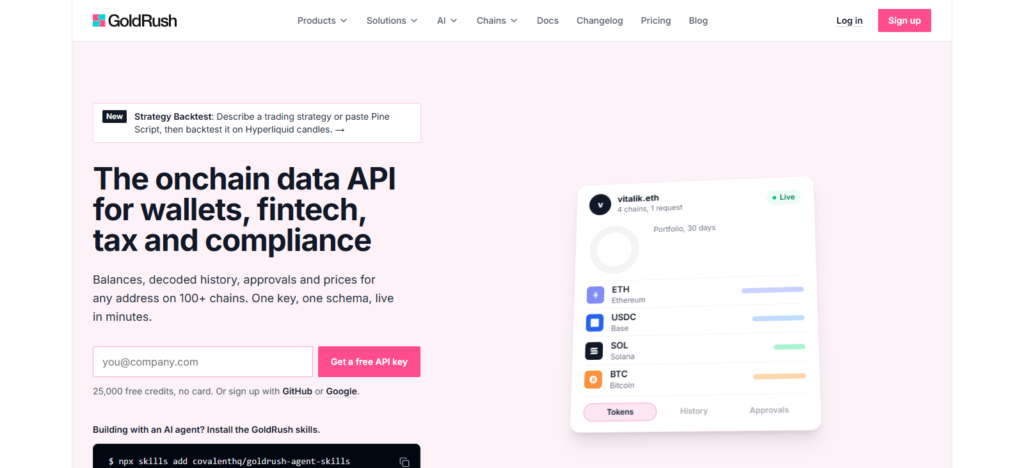
Its main advantage is speed of integration – teams can pull structured wallet, token and DeFi data without building mappings or operating indexing infrastructure.
Coverage varies by chain support tier . Some archived chains have static historical endpoints . GoldRush is a credit-based model, with a 14 day trial that gives you 25,000 credits at four requests per second, and x402 per-request access without signup.
Main Processes
- Collects structured blockchain data on supported networks.
- Offers consolidated APIs to wallet and transaction data.
- Gets token balances and transfer histories.
- Fetch NFT and DeFi data.
- Provides organization of blockchain data for applications and analytics.
Benefits
- Makes multichain data easier to integrate.
- Gives structured information on wallets.
- Provides APIs for token and nft data.
- Reduces the need for custom indexers.
Cons
- API usage may be rate limited.
- Data availability differs across blockchain networks.
- Not as flexible for custom indexing as developer-built solutions.
- The more you use it, the more you pay.
7. Bitquery
Bitquery is a blockchain data and analytics platform offering GraphQL APIs, live streams and warehouse-ready data delivery. It indexes Bitcoin, Ethereum, Solana, BNB Chain, Polygon, Tron, Base, Arbitrum, Optimism, Cardano and other major networks.
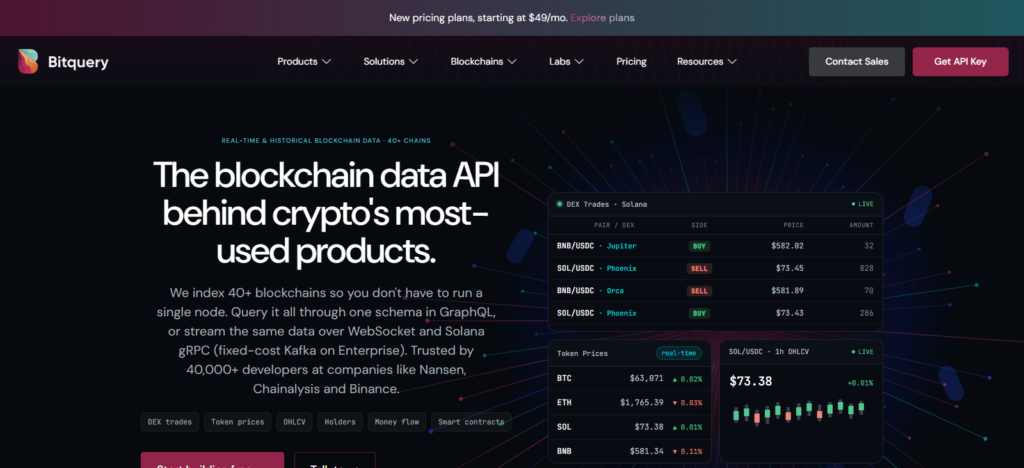
The delivery options are legacy GraphQL, WebSocket streams, Kafka streams over protobuf, Solana gRPC over CoreCast, ClickHouse data warehouse, and exports or cloud datashares to S3, Snowflake, and BigQuery.
This makes Bitquery particularly useful for trading systems, compliance tooling, analytics, and AI agents that require both live and historical data. Developers will need to verify the plan entitlements, as well as the live GraphQL schemas per chain, as interfaces and data coverage vary by network.
Key Processes
- Indexes on-chain events and blockchain operations
- Collects token transfers and DEX data.
- Offers GraphQL APIs for blockchain queries.
- Supports wallet activity and smart contract investigation.
- Processes blockchain data sets for monitoring and analytics.
Benefits
- Extensive blockchain data coverage.
- Provides flexible querying using GraphQL.
- DEX and token analytics support
- Enables fine-grained analysis of blockchain transactions.
Downsides
- Advanced queries require knowledge of GraphQL.
- Large data requests can be expensive in terms of resources.
- API access might be limited in usage.
- Some niche datasets might be behind a paywall.
8. Dune Analytics
Dune Analytics is a blockchain analytics and dashboarding platform that enables users to explore indexed blockchain data using SQL. Instead of mainly providing a custom indexer API, it allows analysts to query curated and community contributed datasets using SQL and then build visual dashboards, charts and alerts.
It covers major EVM ecosystems and many popular protocols, making it strong for market research, protocol analytics, token analytics and business intelligence.
Data is available via Dune’s API for integration into apps and automated reporting, but it’s less suited to low-latency, application-facing custom indexes than The Graph, Envio, or Goldsky. The value is in fast analytical exploration, reusable queries and collaborative public dashboards not bespoke indexing pipelines.
Key Processes
- Structures blockchain data into datasets that can be queried
- Analyzes on-chain transactions using SQL.
- Enables custom queries of the blockchain data.
- Design dashboards for analytics in DeFi and Web3.
- Allows for sharing and discovery of community-built dashboards
Advantages
- Offers easy-to-use blockchain analytics.
- Support for custom SQL queries.
- Offers interactive data dashboards
- It assists in comparing activity between blockchain ecosystems.
Cons
- Advanced analysis requires SQL knowledge.
- Not primarily meant for custom application indexing.
- Query execution can be slow for large data sets.
- Might need paid subscription for advanced usage.
9. Space and Time
Space and Time is a decentralized data warehouse, combining indexed blockchain data, SQL analytics and zero-knowledge proofs. It is aimed at enterprises and Web3 applications that need verifiable queries over large historical data sets, particularly where trust in the query results is important.
It is not a lightweight indexer API, but focuses on warehouse-scale storage, SQL joins, analytics and tamper-evident computation, suitable for financial reporting, risk, compliance and AI/data pipelines.
It plugs into the major blockchain datasets, and delivers results to applications through APIs and data-warehouse workflows. Strengths: scalable SQL analytics, provenance, verifiability. General purpose data APIs can be easier to adopt for teams that want simple wallet or token REST endpoints.
Processes
- Prepares data from the blockchain and external sources into queryable datasets.
- Gives the infrastructure for decentralized data warehousing.
- Enable SQL analytics on blockchain data.
- Proof of SQL for verifiable query result.
- Provides data access for intelligent contracts and applications.
Advantages
- supports queries on verifiable data.
- Combines blockchain with external data.
Access to the data via SQL. - Advocate of decentralized data infrastructure.
Cons
- Technical knowledge is required to implement.
- Complex queries might need to be tuned.
- Integration may require additional development work.
- Supported data sources may have different platform capabilities.
10. Moralis
Moralis is a managed Web3 infrastructure and data platform with prebuilt REST APIs for wallets, tokens, NFTs, prices, DeFi, blockchain data, profit-and-loss, and token search across EVM, Solana, and Bitcoin. Its focus is fast integration and it allows developers to query normalized data without building custom indexers, mappings or GraphQL schemas.
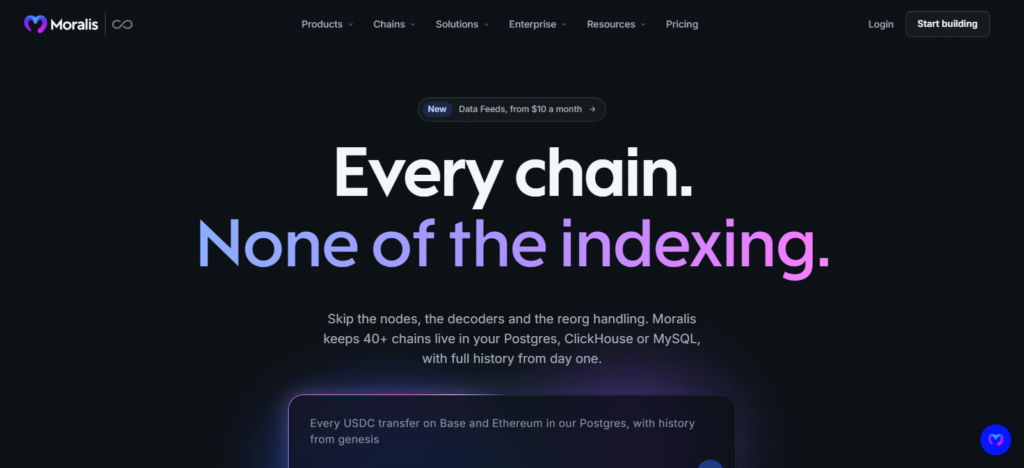
Moralis also provides Streams for real-time event delivery and can push indexed data into a customer’s own database, combining historical and real-time indexing with schema controls. It supports 50+ networks, with specific endpoint coverage varying by product and chain. The Pro plan starts at around $49 a month, and is usage-capped. It’s best for teams that want to get to market fast, rather than fully custom indexing logic.
Main Processes
- Provides developer-friendly APIs for retrieving blockchain data.
- Gives you wallet balances and transaction data.
- Indexing of NFT and token data.
- Offers APIs to communicate with smart contract systems and blockchains.
- Puts blockchain data into Web3 applications.
Benefits
- Offers developer-friendly blockchain APIs.
- Supports wallet, token and NFT data.
- Makes Web3 application development easier.
- Cuts down on the need for bespoke indexing infrastructure.
Drawbacks
- API usage could be rate limited.
- The supported data will vary from blockchain network to blockchain network.
- Further development may be needed for advanced customization.
- Subscription costs could rise with increased API consumption.
How to Choose the Best Blockchain Website Indexing Tool?
Supported Blockchain Networks: Choose a tool that supports your target blockchain networks, such as Ethereum, Solana, Polygon, and other ecosystems, to ensure compatibility with your Web3 project.
Indexing Speed and Performance: Evaluate how quickly the platform processes blockchain transactions, smart contract events, and new blocks to ensure efficient data retrieval and application performance.
API and Query Support: Check whether the tool provides GraphQL, REST APIs, or SQL queries for accessing structured blockchain data and integrating information into applications.
Historical Data Availability: Select a platform that provides access to historical transactions, wallet activities, smart contract events, and token transfers for accurate blockchain analysis.
Real-Time Data Synchronization: Look for real-time indexing and data streaming capabilities to monitor blockchain events, track transactions, and keep decentralized applications updated.
Customization and Integration: Consider custom indexing configurations, data filtering, SDKs, and integration options that allow developers to connect blockchain information with existing applications.
Pricing and Usage Limits: Compare free plans, subscription costs, API request limits, data usage restrictions, and additional charges to select a solution that fits your project budget.
Scalability and Reliability: Choose a platform that can handle increasing data volumes, multiple blockchain networks, and growing application requirements while maintaining consistent indexing performance.
Conclusion
Choosing the right blockchain website indexing tool depends on your project requirements, the networks it can support, indexing speed, API capabilities and your budget. Platforms like The Graph, Subsquid, Goldsky, Envio and SubQuery offer flexible solutions to process blockchain data and support Web3 applications. Covalent, Bitquery, Dune Analytics, Space and Time, and Moralis, in contrast, provide useful capabilities for data retrieval, analytics, and application integration.
Before choosing a platform, look for features such as real-time indexing, access to historical data, scalability, customization and pricing. Having the right indexing tool can make managing blockchain data easier, improve accessibility, and help with efficient decentralized application development.
FAQ
What are blockchain website indexing tools?
Blockchain indexing tools collect, organize, and process on-chain data, making transactions, smart contract events, wallet activities, and token information easier for developers to retrieve.
Which is the best blockchain indexing tool?
The Graph is a popular blockchain indexing platform offering decentralized indexing and GraphQL APIs. Other options include Subsquid, Goldsky, Envio, and SubQuery.
How do blockchain indexing tools work?
These tools collect blockchain data, process transactions and smart contract events, organize information into structured datasets, and provide APIs or query interfaces for retrieving data.
Which blockchain indexing tools support multiple networks?
The Graph, Subsquid, Goldsky, SubQuery, Covalent (GoldRush), and Moralis support multiple blockchain networks, although their individual network coverage varies.
Can blockchain indexing tools provide real-time data?
Yes. Platforms such as Goldsky, Envio, and The Graph support real-time or near-real-time blockchain data processing, depending on network support and configuration.