







AI search is altering how brands are discovered, how products are compared, and how people get answers online. With platforms like ChatGPT, Google AI Overviews, Gemini, and Perplexity getting more powerful, businesses need strategies beyond traditional SEO.
That’s where AI search visibility and Generative Engine Optimization (GEO) consultancies come into play. In this guide I’ll review the Best AI Search Visibility and GEO Consultancies and outline their key services, strengths and specialties to help you select the right partner for your business goals.
How We Evaluated These Agencies
| Evaluation Criteria | What We Considered |
|---|---|
| GEO Expertise | Experience with Generative Engine Optimization and strategies for improving brand visibility in AI-generated answers. |
| AI Platform Coverage | Understanding of ChatGPT, Google AI Overviews, Gemini, Perplexity, and other AI search experiences. |
| Technical SEO | Capabilities in website crawling, indexing, structured data, and technical optimization. |
| Content Strategy | Expertise in creating authoritative, relevant, well-structured content that addresses user questions. |
| Brand Authority and Digital PR | Strategies for earning credible brand mentions, industry coverage, and third-party references. |
| Performance Measurement | Methods for tracking AI citations, brand mentions, referral traffic, and organic search performance. |
| Industry Experience | Experience serving relevant industries, including SaaS, B2B, e-commerce, and enterprise businesses. |
| Transparency and Value | Clarity around service offerings, reporting, engagement models, and publicly available pricing information. |
Quick Comparison Table
| EigenDA Alternative | Core Approach | Key Advantage | Best Suited For |
|---|---|---|---|
| Celestia | Modular DA blockchain | Data availability sampling | Sovereign rollups and appchains |
| Avail DA | Dedicated DA layer | KZG commitments and sampling | Modular rollups |
| NEAR DA | Sharded blockchain-based DA | Existing sharded infrastructure | Cost-sensitive rollups |
| Ethereum blobs | Ethereum L1 blob transactions | Ethereum-native settlement alignment | Ethereum L2 rollups |
| Polygon Avail | Independent DA infrastructure | Modular ecosystem integration | Cross-ecosystem rollups |
| Arbitrum AnyTrust | Data availability committee | Lower-cost L2 data handling | Application-specific chains |
| Optimism OP Stack | Rollup framework with configurable DA architecture | Ethereum rollup ecosystem integration | Optimistic rollups |
| zkSync ZK Stack | ZK-chain framework | ZK-based chain development | ZK rollups and appchains |
| Polygon CDK | Modular chain development kit | Flexible chain deployment | Custom L2s and ZK chains |
| Conduit | Rollup deployment infrastructure | Simplified rollup operations | Teams launching application-specific rollups |
1. Celestia
Celestia is a modular blockchain for data availability (DA) that enables developers to decouple execution from consensus and data storage. Projects can use Celestia to publish and validate transaction data, instead of executing application logic on the base layer. The design is more scalable and flexible for rollups and appchains.
Pricing is not based on the execution costs of smart contract, but on network usage and data posted to the chain. Celestia enables projects to scale more effectively yet remain transparent and secure. It has become a go-to for modular blockchain ecosystems and next-generation Layer 2 networks.
Main Processes
- Data submission. A rollup packages transaction data into blobs and sends the blobs to Celestia.
- Data Encoding: The network employs erasure coding to add redundancy to block data.
- Data Commitment: Merkle-based commitments are committed into block headers.
- Availability Sampling: Light nodes sample data shares to verify the availability of block data.
- Data Retrieval: Rollups and their nodes retrieve the relevant data to reconstruct and verify the transactions.
Pros
- Data Availability: Decouples data availability from execution enabling modular blockchain architectures.
- Efficient Verification: Data availability sampling decreases the requirement for light nodes to download full blocks.
- Flexible Integration: Different rollups can share a DA layer.
- Data Isolation: Applications can query their own relevant data via Namespaced Merkle trees.
Downsides
- External Dependency: Rollups depend on Celestia network and availability guaranties.
- Further Integration: Developers must set up data submission, retrieval and verification.
- Independent Security Model: DA security depends on consensus and sampling assumptions of Celestia.
- Historical Data Management: Long term data access may require archival nodes or other providers.
2. Available DA
Avail DA is a dedicated data availability layer that provides an efficient way for rollups, appchains and decentralized applications to publish and verify transaction data. It is built with cutting edge data availability sampling techniques that enable nodes to validate large chunks of data without having to download the entire data.
This lowers infrastructure expenses and enhances scalability. Pricing is typically based on data storage and network usage, which is appealing for projects seeking predictable operational costs. Avail is a security, decentralization and accessibility focused protocol that helps developers launch high-throughput blockchain applications with reliable data availability guaranties.



Important Processes
- Data Preparation – Rollups prepare transaction data into usable formats.
- Data Posting: The rollup posts data to the Avail network.
- Data Commitments: Cryptographic commitments recognize the data submitted.
- Availability check: Light clients verify data availability by sampling and proofs.
- Data Retrieval: nodes retrieve published data to reconstruct/verify the rollup state.
Advantages
- Dedicated DA Layer: Specifically built for modular blockchain infrastructure.
- Efficient Verification: Enables light-client verification without downloading all block data.
- Modular Support: It can support compatible rollups and execution layers.
- Ensuring Data Integrity: Cryptographic proofs can be used to verify published data.
Drawbacks
- Avail Dependency: Rollups depend on Avail’s availability and consensus guaranties.
- Integration Requirements: Compatible tools and data retrieval systems are needed.
- Other Costs: There are network costs of publishing data.
- Ecosystem Maturity: Developers need to assess the integrations and operational support available.
3. NEAR DA
NEAR DA is the NEAR ecosystem’s data availability solution, offering rollups and application-specific chains an affordable and scalable way to store data. It uses NEAR’s high-performance infrastructure and sharding capabilities to process massive amounts of data at a relatively low cost.
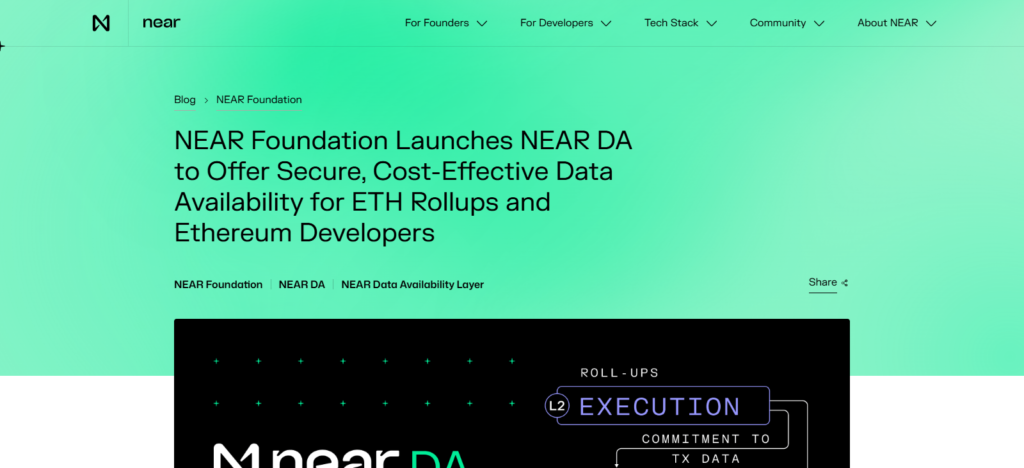
Pricing is typically based on the amount of data posted, helping developers building scalable Layer 2 solutions to save costs. Built to reduce overhead for developers and enhance blockchain performance, NEAR DA offers fast finality, reliable security and integration opportunities for various decentralized ecosystems.
Main procedures
- Batching transactions. The rollup aggregates transactions in batches.
- Data Submission: Data is submitted via a compliant NEAR DA integration.
- validation of publication: the system verifies that the data is accepted and published.
- Data Retrieval: Rollup nodes or providers fetch the needed data.
- State Reconstruction The information retrieved can be used to rollup state reconstruction and verification.
Benefits
- Alternative DA Infrastructure: Provides an alternative way to publish data, besides the Ethereum-native way.
- Cost Efficiency Potential: Can potentially lower data publication costs for appropriate workloads.
- Modular Design: Decouples data availability from execution.
- Infrastructure reuse: Leverages existing blockchain infrastructure of the NEAR ecosystem.
Drawbacks
- Integration Complexity: Compatibility depends on the rollup stack.
- External security assumptions. Guaranties depend on the architecture.
- Retrieval Requirements: Nodes must be able to reliably retrieve published data.
- Variable Costs: Fees depend on network conditions and amount of data
4. Ethereum Blobs
Ethereum Blobs Scaling upgrades on Ethereum were meant to give rollups cheaper data storage. Blobs are used to store temporary data for layer 2 networks, rather than storing all transaction data on-chain forever. This significantly cuts operational costs and boosts transaction throughput. The separate blob fee market efficiently manages demand.
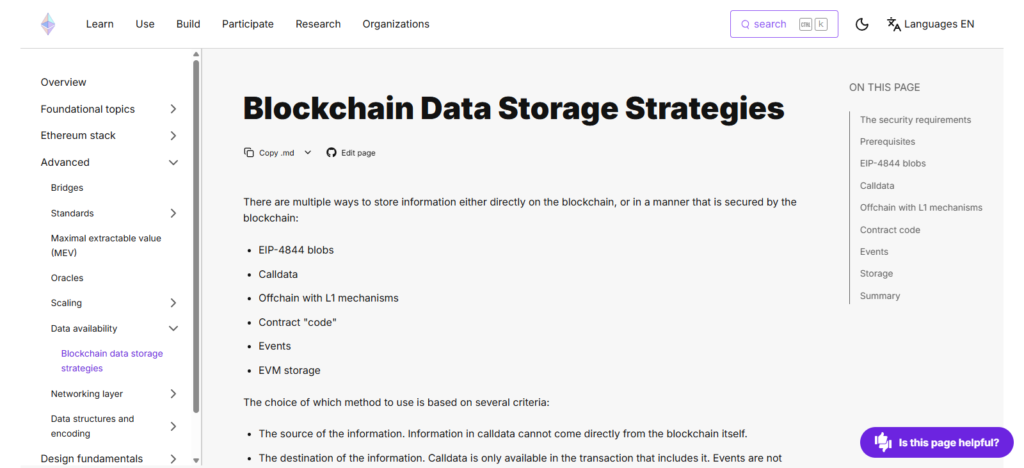
Ethereum blobs support the rollup-centric roadmap by taking advantage of Ethereum’s security model while reducing the cost of Layer 2 transactions. They are a big player in scaling dapps and enhancing user experience throughout the ecosystem.
Main procedures
- Batching transactions. The rollup aggregates transactions in batches.
- Data Submission: Data is submitted via a compliant NEAR DA integration.
- validation of publication: the system verifies that the data is accepted and published.
- Data Retrieval: Rollup nodes or providers fetch the needed data.
- State Reconstruction The information retrieved can be used to rollup state reconstruction and verification.
Benefits
- Alternative DA Infrastructure: Provides an alternative way to publish data, besides the Ethereum-native way.
- Cost Efficiency Potential: Can potentially lower data publication costs for appropriate workloads.
- Modular Design: Decouples data availability from execution.
- Infrastructure reuse: Leverages existing blockchain infrastructure of the NEAR ecosystem.
Drawbacks
- Integration Complexity: Compatibility depends on the rollup stack.
- External security assumptions. Guaranties depend on the architecture.
- Retrieval Requirements: Nodes must be able to reliably retrieve published data.
- Variable Costs: Fees depend on network conditions and amount of data
5. Polygon Avail
Polygon Avail originally was created by Polygon as a dedicated data availability solution before it was spun out as an independent ecosystem project. The goal is to assist developers in building scalable rollups and application chains without relying on expensive on-chain storage only.
Polygon Avail enhances security and reduces verification costs with data availability sampling and a modular architecture. Pricing is mainly based on data posted to the network so it is suitable for high-volume applications. The modular architecture offers more flexibility, allowing projects to customize execution environments, while also providing secure, verifiable access to data.
Major Processes
- Data Preparation: Rollups prepare transaction data for public release.
- Data Submission: Data is submitted via a compatible Avail integration.
- Data Commitment: Cryptographic commitments specify the published data.
- Availability check: light clients check availability via supported proofs and sampling.
- Data Retrieval: Nodes need to retrieve data to reconstruct and verify rollup state.
Pros
- Modular Architecture: DA and execution are separated.
- Efficient Verification: Enables lightweight availability checks.
- Works With Rollup: Supports compatible modular rollup systems.
- Cryptographic Integrity: Published data can be verified with proofs.
Disadvantages
- Duplicate Listing: This is not a separate alternative to Avail DA.
- Integration work: Rollups will require interoperable tooling for submission and retrieval.
- External Dependency: The availability depends on the underlying Avail network.
- Historical Retrieval: Long-term access may require archival arrangements
6. Arbitrum AnyTrust
Arbitrum AnyTrust is a scaling framework that uses a Data Availability Committee (DAC) to achieve low-cost transactions. Trusted committee members provide access to transaction data, not store all data directly on-chain. This approach reduces operational costs by a great magnitude and accelerates the rate of transactions.
It is normally less expensive than traditional rollup models because less information has to be published to Ethereum. AnyTrust is especially useful for gaming, social platforms and consumer applications that need high throughput. It balances scalability, efficiency and security while remaining compatible with the broader Ethereum ecosystem.
Essential Processes
- Batch Transactions: The rollup collects the transactions.
- Committee Submission: Batch data are submitted to a data availability committee (DAC).
- Availability Attestation: Committee members attest to the availability of the data according to the protocol.
- On-Chain Commitment: The corresponding certificate or commitment is stored on the parent chain.
- Data Recovery: Participants can request the data of committee members when needed.
Advantages
- Lower Data Costs: Reduces the need to publish all transaction data on Ethereum.
- High Throughput Capabilities: Supports high volume of transaction data workloads.
- Nitro Compatibility : Powered by Arbitrum Nitro.
- Operational Efficiency: Customizable for application-specific chains with high transaction volumes.
Drawback
- Committee Trust Security relies on the assumptions on the committee of the protocol.
- Availability Risk: Unprovided data can make recovery difficult.
- Operational Requirements: Members of the Committee need a reliable data infrastructure.
- Trust Trade-Off: It doesn’t have the same availability model as publishing all data directly to Ethereum
7. Optimism OP Stack
Optimism OP Stack is an open-source development framework for building Ethereum-compatible Layer 2 networks. It offers modular components for execution, settlement and data availability, allowing developers to tailor the infrastructure to the needs of the project. Pricing depends on the volume of transactions, costs of settlement and selected solutions of DAs.
The OP Stack is part of the broader Superchain vision, where multiple chains run on common standards and interoperability features. Its flexibility, developer-friendly architecture and strong Ethereum compatibility have seen it widely adopted by projects looking to deploy their blockchains in a scalable and efficient way.
Must-Have Processes
- Chain Setup: Developers set up the rollup components and DA architecture.
- Transaction Sequencing The sequencer orders transactions and forms blocks.
- Batch Formation: Transaction data is grouped into batches.
- Data Publication: Batches are published using the configured DA mechanism.
- Settlement and Verification: The chain executes commitments and verifies state as per its architecture.
Pros
- Modular Design: Enables customizable blockchain components.
- Developer Ecosystem: Leverages existing rollup tooling.
- Flexible Infrastructure: The chain can be tailored to the requirements of the application.
- Deployment Flexibility: Enables building application-specific chains.
Disadvantages
- Not a DA Network on Its Own: Needs another DA mechanism.
- Technical Complexity: Deployment involves meticulous configuration and testing.
- Configuration dependent security: the guaranties are dependent on the choice of the DA and settlement models.
- Operational Overhead: Maintenance is required for sequencers, nodes, upgrades and monitoring
8. zkSync zk-stack
zkSync ZK Stack is a zero-knowledge-powered framework for building sovereign or interconnected blockchains. It uses cryptography proofs to efficiently verify that the transaction is legitimate with the least amount of data to be processed.
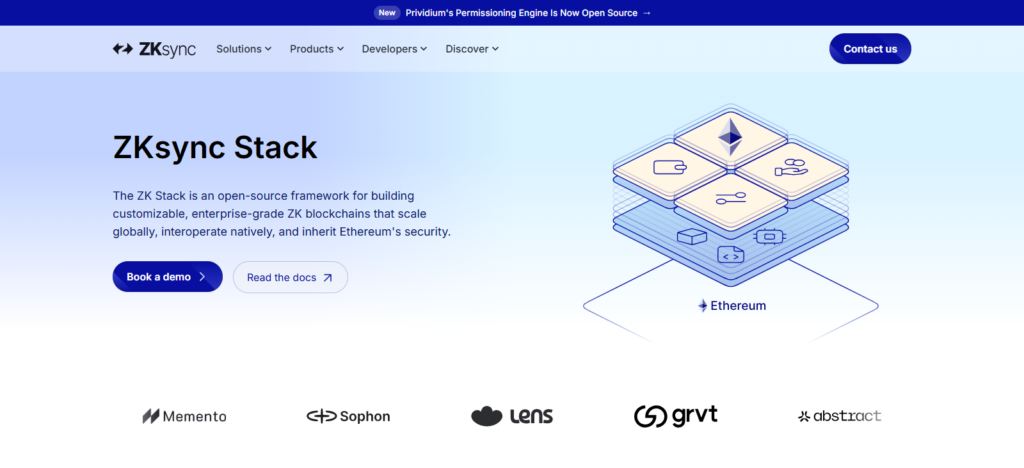
This makes things more scalable, private and secure. Pricing is influenced by usage, proof generation needs and data availability infrastructure. Developers are able to deploy custom chains on ZK Stack that are interoperable with other zkSync-powered networks. The focus on performance and cryptographic security makes it attractive for enterprise and decentralized app development.
Main Processes
- Chain Architecture: The chain architecture and DA model are selected by developers.
- Transaction Execution: The system executes transactions and computes state changes.
- Data Preparation Transaction or state data is prepared for release
- Proof Generation: The system generates validity proofs and processes commitments in accordance with the DAs according to the configuration.
- Settlement: The configured settlement architecture verifies proofs and state commitments.
Benefits
- Validity proofs: Enables cryptographic verification of state transitions.
- DA Flexibility: Supports various DA configurations.
- Customizable Chains: Allows the application-specific development of ZK-powered blockchains.
- Ecosystem Integration: Supports the development of the ZKsync chain ecosystem.
Downsides
- Complexity of Implementation: ZK systems require specialized engineering.
- Computational Costs: The generation of proofs can be computationally expensive.
- Security Tradeoffs: External DA configurations have different assumptions than Ethereum rollups.
- Integration Overhead: DA setup requires compatible infrastructure and verification logic
9. Polygon CDK (Content Development Kit)
Polygon CDK (Chain Development Kit) is a toolkit for developers to build custom Layer 2 and zk-powered blockchain networks. It allows projects to select components that align with their scaling, governance and interoperability goals, based on modular architecture principles. Pricing is based on deployment structure, infrastructure requirements and transaction activity.
Polygon CDK is compatible with Ethereum and it benefits from the use of advanced zero-knowledge technology. This design is flexible and connected to the ecosystem, enabling independent chains to communicate effectively with each other, while retaining strong security and scalability features for long-term growth.
Key Processes
- Chain Design: Developers design the architecture they want the blockchain to have.
- DA Selection: The team select a supported data availability mechanism.
- Sequencing and Execution: The chain orders and processes transactions.
- Data Publication: Transaction data or relevant state data is published via the selected mechanism.
- Settlement and Verification The chain validates state transitions based on the chain configuration.
Advantages
- Configurable Architecture: Support for building application specific blockchain.
- ZK-Oriented Development: Facilitates ZK-based chain configurations.
- DA Flexibility: Supports Data Availability Arrangements
- Deployment Options: offers tools to deploy private blockchain networks
Disadvantages
- Not DA Layer: Need separate DA mechanism.
- Configuration complexity: Different chain configurations need to be tested carefully;
- Security Variable (Dependent on DA and settlement architecture.
- Maintenance Requirements: Teams need to take care of infrastructure and upgrades
10. Conduit
Conduit is a rollup infrastructure platform that makes it easy to deploy and manage blockchain networks. Instead of creating heavy infrastructure from first principles, projects can deploy rollups on popular frameworks like OP Stack and Arbitrum technology. Pricing is typically based on service-oriented infrastructure models with the size of the network, number of transactions and operational requirements dictating the pricing model.
Conduit is a platform that simplifies tech and accelerates blockchain deployments. Managed services, monitoring tools and developer support help teams get production networks out quickly while keeping them reliable, scalable and compatible across the major blockchain ecosystems.
Essential Processes
- Rollup Configuration Developers choose a supported rollup stack and configuration.
- Infrastructure provisioning: The platform assists in deploying the necessary chain infrastructure.
- Sequencer Setup: Configure transaction sequencing and execution components.
- DA Integration: The rollup uses a DA system that is backed by its stack and deployment choice.
- Operations and Monitoring: Teams monitor the performance of the chain and operate the deployed infrastructure.
Advantages
- Easy Deployment: Reduces manual cost to deploy rollups.
- Faster Setup: Tooling support for supported rollup configurations.
- Operational Support: Can help reduce infrastructure management and monitoring burdens.
- Developer Productivity: Teams can spend more time on applications and less time on deployment infrastructure.
Cons
- Platform Dependence: Teams could rely on Conduit’s services and supported integrations.
- Configuration Restrictions: Options vary based on the chosen stack and deployment.
- Running Costs: There may be charges for managed infrastructure and additional services.
- Not a Dedicated DA Network Conduit is primarily a deployment infrastructure, not a standalone DA consensus layer.
How to Choose the Best AI Search Visibility and GEO Consultancy?
GEO Experience: Pick a consultancy that has a track record in Generative Engine Optimization, AI search visibility, and ways to get brands seen in relevant AI-generated responses.
AI Platform Coverage – Make sure the consultancy understands ChatGPT, Google AI Overviews, Gemini and Perplexity and their different approaches to sourcing and presenting data.
Real Case Studies: Learn about real client results, concrete instances, and measurable benefits in terms of AI citations, brand mentions, organic visibility and qualified website traffic.
Technical SEO Expertise: Choose a team that is knowledgeable in crawlability, indexing, structured data, website architecture, and the technical improvements needed for search engines to access and understand your content.
Content Strategy: Choose consultancies that generate accurate, useful, well-organized content, backed by credible information, topical expertise, and clear answers to users’ questions.
Digital PR Capabilities: Evaluate the consultancy’s capacity to establish brand authority via relevant publications, credible third-party mentions, industry coverage, and trustworthy online references.
Performance Measurement: Confirm that the consultancy monitors AI-generated mentions, citations, referral traffic, relevant search visibility, and business outcomes through consistent reporting methods and well-defined metrics.
Pricing and scalability Check service packages, contract terms, reporting frequency, and resources available to compare and find a consultancy that fits your budget and can support ongoing business growth.
Final Thought
The right AI search visibility and GEO consultancy for you will depend on your business goals, industry, budget and existing SEO strategy. The right agency will combine technical SEO, authoritative content, digital PR, and AI visibility tracking to drive brand mentions and citations across platforms like ChatGPT, Gemini, Perplexity, and Google AI Overviews.
Before you make your choice, compare the services, industry expertise, transparent reporting, and verified case studies of each consultancy. Avoid being seduced by assurances of guarantyd rankings or citations; rather, seek tangible improvements in AI visibility, qualified referral traffic and business results.
Frequently Asked Questions
What is an AI search visibility consultancy?
An AI search visibility consultancy helps businesses improve how their brands, products, and content appear in AI-generated answers across platforms such as ChatGPT, Gemini, Perplexity, and Google AI Overviews.
What is Generative Engine Optimization (GEO)?
Generative Engine Optimization (GEO) is the practice of improving content and brand presence to increase the likelihood of being mentioned, cited, or recommended in AI-generated responses.
How is GEO different from traditional SEO?
Traditional SEO focuses primarily on improving visibility in search engine results, while GEO focuses on brand representation and citations in AI-generated answers. Both approaches can complement each other.
Which AI platforms should GEO consultancies target?
Businesses may prioritize ChatGPT, Google AI Overviews, Gemini, and Perplexity based on their audience and industry. Platform coverage and citation behavior can vary by consultancy and service offering.
How do you choose the best GEO consultancy?
Evaluate the consultancy’s GEO experience, technical SEO capabilities, content strategy, digital PR expertise, AI platform coverage, case studies, reporting methods, and pricing transparency.