




This article reviews the Top AI Answer Tracking Platforms for SEO Teams. I will focus on tools for AI Answer tracking, Brand Name Mentions, Citations, Competitors, Prompts, and Visibility. I will show how these platforms help SEO teams identify the performance gaps caused by AI search and explain how these tools can help in measuring search performance and tracking changes.
These tools also provide opportunities for content creation and improve brand visibility within emerging answer engines and Accessible AI-based search interfaces.
What Are AI Answer Tracking Platforms?
AI answer tracking tools allow SEO and marketing teams to track mentions of brands, products, websites, and competitors that appear in AI-generated search answers. These tools measure sentiment analysis as well as track changes in various AI search and answer platforms.
Unlike most SEO tools that focus on ranking keywords and website positions, AI answer tracking tools are designed to address how frequently and in what position brands are mentioned in AI-generated answers.
AI answer tracking tools also provide insight to which website domains or content sources that AI cites. Gaps in visibility can also be resolved in addition to helping teams optimize their content and understand how their brand is viewed across multiple AI search platforms.
How We Evaluated These AI Answer Tracking Platforms for SEO Teams
| Criteria | What to Examine |
|---|---|
| AI Engine Coverage | Check which AI answer engines the platform monitors, such as ChatGPT, Google AI Overviews/AI Mode, Gemini, Perplexity, Claude, Copilot, and other supported engines. |
| Prompt Tracking | Examine the number of prompts supported, custom prompt options, tracking frequency, prompt research, and historical prompt performance. |
| Brand Mention Tracking | Check whether the platform identifies when, where, and how frequently a brand appears in AI-generated answers. |
| Citation Tracking | Examine whether it identifies cited URLs, domains, citation frequency, and the content sources used by AI answers. |
| Competitor Monitoring | Check whether teams can compare brand visibility, mentions, citations, and competitor presence across tracked prompts. |
| AI Share of Voice | Examine how the platform calculates brand visibility compared with competitors across AI-generated answers. |
| Sentiment & Brand Context | Check whether the platform identifies positive, negative, or neutral brand references and how the brand is described by AI. |
| Geographic Tracking | Examine country, region, language, and market-level tracking capabilities for international SEO programs. |
| Historical Data | Check whether teams can compare AI visibility, citations, mentions, and competitors over time. |
| AI Visibility Reporting | Examine dashboards, trend reports, customizable reports, exports, scheduled reporting, and client reporting capabilities. |
| SEO Integration | Check how well AI-answer data connects with keyword rankings, content research, technical SEO, backlinks, or existing SEO workflows. |
| Content Recommendations | Examine whether the platform turns AI visibility gaps into content, optimization, or citation recommendations. |
| Content Optimization | Check whether the tool can identify pages or topics that could be improved to increase AI visibility. |
| AI Crawler Insights | Examine whether it provides information about AI crawlers, bot activity, website accessibility, or how AI agents interact with the site. |
| Competitor Citation Sources | Check whether teams can discover which websites and pages are being cited for competitors but not for their own brand. |
| Accuracy Monitoring | Examine whether the platform can identify incorrect, outdated, or misleading AI-generated information about the brand. |
| API & Data Export | Check API availability, CSV/JSON exports, data access, and compatibility with internal SEO or BI workflows. |
| Team Collaboration | Examine users, workspaces, permissions, project management, and collaboration features for SEO teams and agencies. |
| Scalability | Check prompt limits, projects, domains, markets, competitors, users, and AI responses supported at higher plans. |
| Pricing & Usage Model | Compare subscription cost, prompt limits, credits, response limits, add-ons, free trials, and enterprise pricing. |
| Ease of Use | Examine setup time, dashboard usability, prompt creation, filtering, data interpretation, and day-to-day workflow. |
| Actionability | Check whether the platform only reports AI visibility or also helps the SEO team decide what content, technical, or authority improvements to make. |
Quick Comparison Table
| Platform | Best For | Key Strengths | Limitations |
|---|---|---|---|
| Dageno AI | SEO teams needing monitoring + execution | Connects prompts, citations, competitors, and content workflows | Not a full technical SEO crawler |
| Profound | Enterprise prompt intelligence | Deep analysis of prompts, answers, and sources | Heavy platform, overkill for small teams |
| Scrunch AI | Enterprise visibility + AI crawler access | Combines monitoring with technical agent access | Requires technical ownership |
| AthenaHQ | Cross-functional GEO programs | Unified workspace for monitoring + optimization | Needs clear governance process |
| Semrush AEO | Existing Semrush customers | Adds AI visibility to SEO suite | Prompt workflows less advanced |
| Ahrefs Brand Radar | Large-scale competitor research | Strong research context across web + AI | Less prescriptive for page-level fixes |
| Peec AI | Focused AI search analytics | Clear visibility, source, competitor reporting | Needs separate SEO execution tools |
| OtterlyAI | Small teams & pilots | Accessible prompt/citation monitoring | Light for enterprise governance |
| Brandlight | Global enterprise brand intelligence | Multi-brand, multi-region visibility | More than basic SEO use cases |
| SE Ranking AI Tracking | Agencies & SE Ranking users | AI tracking within familiar SEO workflow | Less granular than specialist platforms |
1. Dageno AI
Dageno AI began operation in 2024 out of New York City, USA, and has become a premier AI-based answer tracking tool for SEO teams. At $1,500 per month, Dageno AI’s product includes the monitoring of AI-generated answers from ChatGPT, Gemini, Claude, and Copilot for SEO teams, providing information on answers, citations, and mentions of competing products/brands.
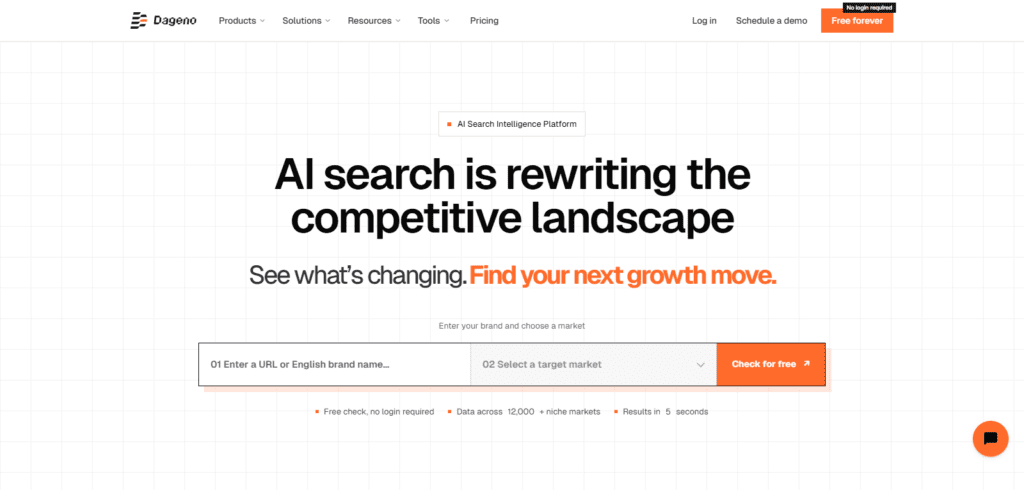
Dageno AI integrates with SEO workflows for teams to respond to the information and adjust their content strategies. Dageno AI has differentiated itself from its competitors by providing a tool for the monitoring of AI-based answer generation and response adjustment all in a single tool for SEO teams.
Process
- Monitors AI-based search and answer environments for brand visibility.
- Tracks prompts, brand names, competitor names, citations, and visibility trends.
- Identifies competitor visibility strongly driven by AI and content gaps.
- Converts the visibility findings to GEO, AEO, SEO, and content recommendations.
- Links the monitoring capability to the content generation and result attribution workflows.
Feature Snapshot
| Feature | Details |
|---|---|
| Founded Year | 2024 |
| Headquarters | New York, USA |
| Pricing | Starts at $1,500/month |
| Core Service | AI answer tracking across ChatGPT, Gemini, Claude, Copilot |
| Specialization | Monitoring citations, competitor mentions, brand positioning |
| Integration | SEO workflow integration for actionable insights |
| Target Users | Mid-sized enterprises and agencies |
| Strength | Combines monitoring with execution |
| Limitation | Not a full technical SEO crawler |
Pros
- Integrates AI visibility monitoring and optimization workflows.
- Offers prompt and competitor visibility analysis.
- Provides citation and content-gap insights.
- Links data to content generation workflows.
- Best suited for teams for which measurement and execution are integrated in a single tool.
Cons
- Wireframe and UX capabilities require more platform set up beyond simple monitoring tools.
- Multiple workflow features are likely an unnecessary resource for teams needing basic tracking.
- For teams wanting value, a defined GEO/AEO strategy is required.
- Content generation workflows still need human oversight.
- Teams with an ongoing optimization goal will likely need more extensive workflows.
2. Profound
Profound was formed in 2022 and is based out of London, United Kingdom, for enterprise-level AI prompt intelligence. Founded at the $5,000 per month mark, Profound offers deep social analytical capabilities. Profound’s area of specialization is dissecting prompts and answers across various AI-based search engines and citation providers for how brands are represented.

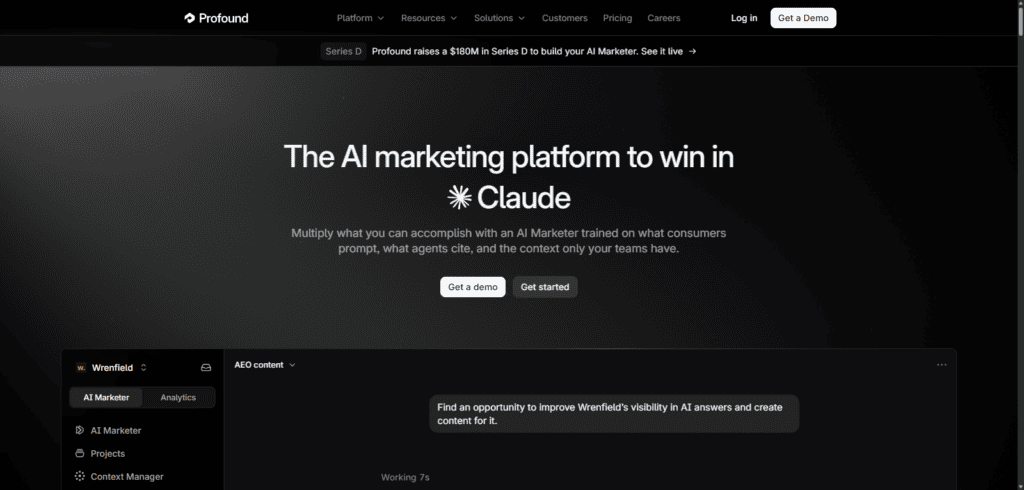
Profound’s offering lends itself best to enterprise-level governance for managing a company’s visibility for multiple brands. Profound is highly valued by large SEO teams for offering deep intelligence on competitors’ prompt usage and answer frameworks. Profound has a strong reputation of offering deep analysis coupled with enterprise-grade reporting.
Process
- Creates tracked prompts for monitoring AI answer visibility.
- Measures brand and competitor appearances across supported answer engines.
- Analyzes citations, sources, sentiment, and answer-engine visibility.
- Provides data and analytics for understanding AI search performance.
- Can connect insights with content and agent-based workflows on higher plans.
Feature Snapshot
| Feature | Details |
|---|---|
| Founded Year | 2022 |
| Headquarters | London, UK |
| Pricing | Starts at $5,000/month |
| Core Service | Enterprise prompt intelligence |
| Specialization | Deep analysis of prompts, answers, citations |
| Target Users | Large SEO teams and enterprises |
| Strength | Governance and competitor strategy insights |
| Limitation | Heavy platform, complex for small teams |
| Industry Fit | Enterprise-scale SEO governance |
Pros
- Strong enterprise-oriented AI visibility analytics.
- Provides detailed prompt and citation intelligence.
- Includes competitor and sentiment analysis.
- Supports exports and API capabilities on higher tiers.
- Useful for organizations managing larger AI-search programs.
Cons
- Advanced capabilities may require higher-tier plans.
- Starter-level monitoring is more limited.
- Enterprise features can make the platform more complex for small teams.
- Multiple data dimensions require interpretation by an SEO or marketing team.
- May be more functionality than needed for simple brand-mention monitoring.
3. Scrunch AI
Scrunch AI began operating in 2023 and calls the San Francisco Bay Area home. Their focus is enterprise visibility, bolstered by an AI crawler.
Scrunch AI’s pricing starts at $3000 for large corporations. Scrunch AI’s tools can crawl websites and add hand tool accessibility to view things like how and why content is ranking. They offer their services to multiple industries like E-Commerce, Finance, and Media.
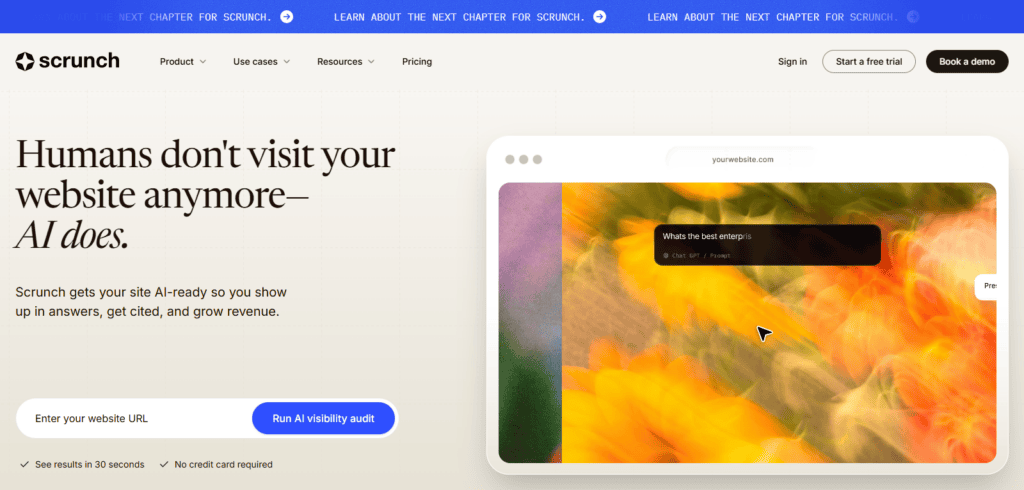
Their technology allows clients hands-on control of AI driven search systems onsite. Because of their advanced technology and monitoring services, they have built a solid reputation as the go to service for large companies.
Process
- Monitors prompt engagement across AI answer platforms.
- Mentions brands, citations, sources, competitors.
- Analyzes how AI systems engage with, and interpret, site content.
- Site audits identify content and technical site gaps.
- Offers suggestions for augmenting AI visibility and site readiness.
Feature Snapshot
| Feature | Details |
|---|---|
| Founded Year | 2023 |
| Headquarters | San Francisco, USA |
| Pricing | Starts at $3,000/month |
| Core Service | AI visibility + crawler access |
| Specialization | Technical agent access for AI crawlers |
| Target Users | Large organizations |
| Strength | Combines monitoring with technical depth |
| Limitation | Requires technical ownership |
| Industry Fit | E-commerce, finance, media |
Pros
- Integrates AI visibility, site auditing, and citation/source analysis.
- Offers competitor visibility.
- Includes recommendations for improvement.
- Useful for making sites more accessible to AI agents.
Cons
- Some features available only on higher plans.
- Site audits could be an unnecessary addition for monitoring teams.
- requires more workflow management.
- May not be used to their full extent by teams with a focus on prompt tracking.
- Customized packages may be needed for client requirements.
4. AthenaHQ
AthenaHQ was founded in 2022 and provides a unified workspace for AI search visibility and optimization. Pricing starts at $2,500 with their target audience of mid-sized and larger enterprise SEO teams. They focus on cross-functional governance allowing for collaboration between a wide array of teams including marketing, SEO, and compliance.
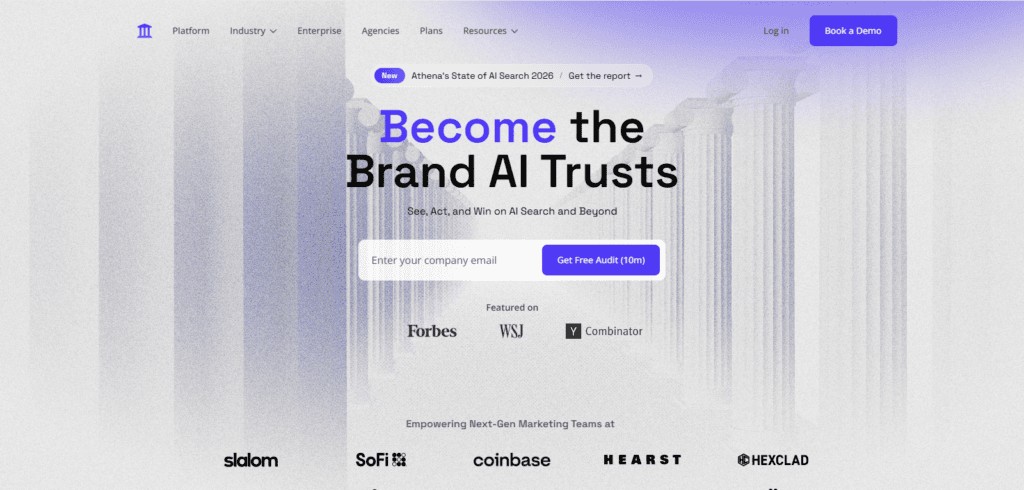
Their product integrates the functions of monitoring, optimizing, and reporting into one tool for ease of use when managing AI search systems. They advocate for governance and collaboration providing organizations the tools to align their efforts in a unified workspace. For large companies focused on managing AI search and visibility AthenaHQ is a trusted partner.
Process
- Monitors brand visibility across multiple AI answer engines.
- Gathers data regarding prompts, competition, citations, and brand sentiment.
- Identifies how AI systems represent a brand.
- Employs visibility data to optimize results.
- Integrates monitoring data with recommendations and content optimization within a single workflow.
Feature Snapshot
| Feature | Details |
|---|---|
| Founded Year | 2022 |
| Headquarters | Berlin, Germany |
| Pricing | Starts at $2,500/month |
| Core Service | Unified workspace for AI visibility |
| Specialization | Governance + optimization |
| Target Users | Mid-sized and enterprise SEO teams |
| Strength | Cross-functional collaboration |
| Limitation | Needs clear governance setup |
| Industry Fit | Enterprises managing AI SEO programs |
Pros
- Monitors visibility across multiple AI platforms.
- Includes competitor and sentiment analysis.
- Provides brand representation monitoring.
- Optimization suggestions are included.
- Includes enterprise-level control and workflow options.
Cons
- Advanced features geared towards larger teams.
- Enterprise options may increase complexity of the implementation.
- Teams must understand AI visibility metrics.
- May be excessive for businesses that only need basic prompt tracking.
- Credit-based usage requires monitoring consumption.
5. Semrush AEO Module
Semrush was launched in 2008, in Boston, USA, and introduced its AI visibility layer, the AEO (AI Engine Optimization) module, in 2025. Semrush AEO starts at $199 per month, a price that most Semrush customers would be able to afford, and uses AI to add tracking for answer position to the whole Semrush SEO suite. With this, users can now analyze their competitor mentions and citations.
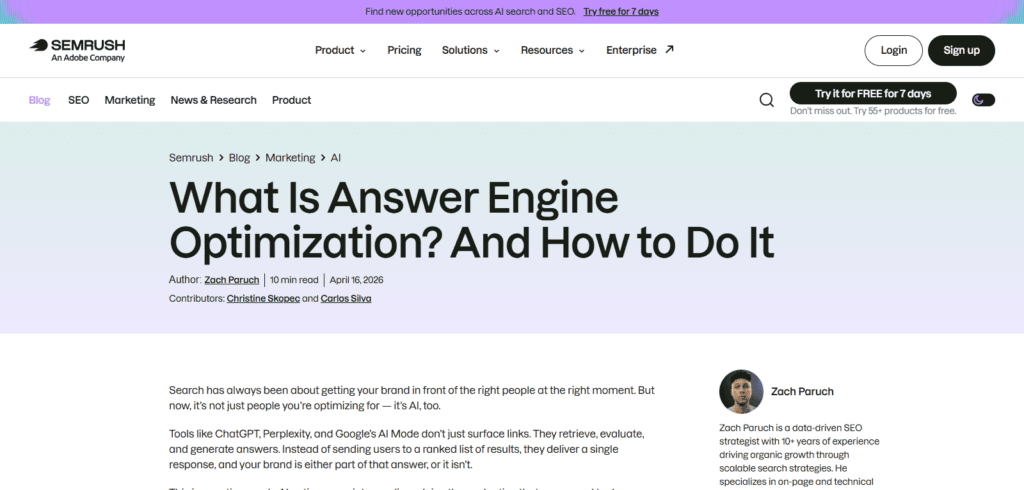
It helps users who run Semrush to do keyword research, analyze backlinks, and optimize content. It’s worth noting that Semrush AEO uses its capability for ease of integration to seamlessly help manage the traditional and AI-based visibility for an SEO team from the same tool. For its suite extension, Semrush bets on being the all-in-one solution for modern day SEO.
Process
- Relies on traditional SEO and AI search visibility data.
- Tracks brand presence and visibility within supported AI search spaces.
- Integrates AI search data with competitor and keyword analysis, along with content data.
- Reveals opportunities for search and AI visibility.
- Allows more seamless integration for AI visibility within traditional SEO work processes.
Feature Snapshot
| Feature | Details |
|---|---|
| Founded Year | 2008 (AEO launched 2025) |
| Headquarters | Boston, USA |
| Pricing | Starts at $199/month |
| Core Service | AI Engine Optimization module |
| Specialization | AI visibility within Semrush suite |
| Target Users | Existing Semrush customers |
| Strength | Seamless integration with SEO tools |
| Limitation | Prompt workflows less advanced |
| Industry Fit | Agencies, SEO professionals |
Pros
- Offers seamless integration of visibility data within traditional SEO work processes.
- Useful for organizations already using Semrush.
- Integrates SEO and AI search data.
- Has a competitor analyzer and content data.
- Integrates work processes with AI search and traditional SEO
Cons
- May feel less focused due to the broad range of SEO functionality.
- Teams focused only on monitoring AI-answer behavior may not need the full ecosystem.
- Feature availability may differ among plans.
- Users may need to use many different Semrush modules.
- Balance of complexity and functionality may drive greater requirements for your overall subscription.
6. Ahrefs Brand Radar
Ahrefs, founded in 2010, set up its headquarters in Singapore and started the Brand Radar service in 2025 for AI-focused brand placement. With a price of $299/month, it targets Ahrefs’ existing customers. Ahrefs Brand Radar focuses on one of the early stages of competitor research and brand placement, monitoring AI Search, and seeing how brands are placed in the AI-generated answers.
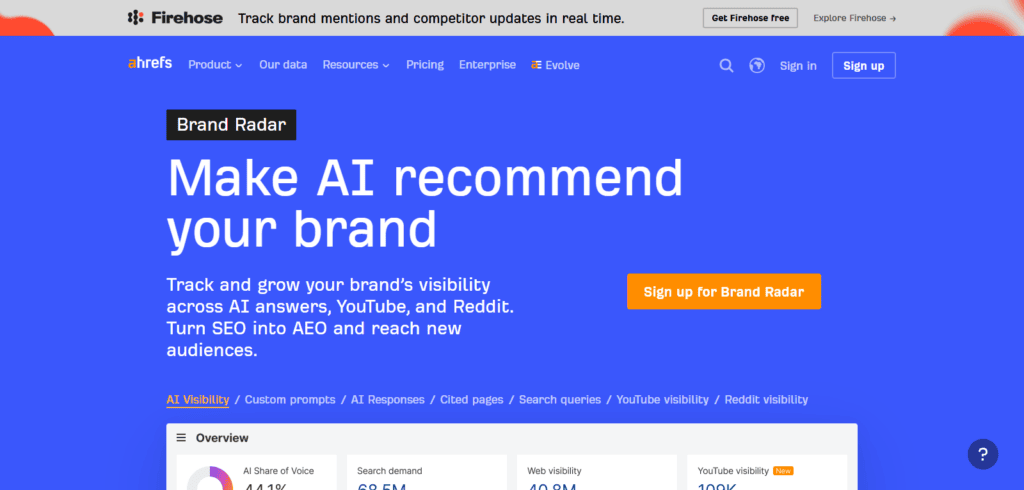
The tool integrates with Ahrefs’ current backlink and keyword tools, giving customers a more zoomed out view of their SEO efforts. Ahrefs Brand Radar has quickly become known for its thorough research, and helps SEO teams understand competitor placement in AI Search. By combining traditional SEO with AI visibility, Ahrefs is securing a spot for itself as one of the premier research-centric AI-centered SEO tools.
Process
- Tracks brand visibility within AI-generated answers.
- Monitors brand and competitor mentions across supported platforms.
- Analyzes AI citations and the sources appearing in answers.
- Uses search-backed prompt data to investigate AI visibility.
- Connects AI-answer insights with broader search and content research.
Feature Snapshot
| Feature | Details |
|---|---|
| Founded Year | 2010 (Brand Radar launched 2025) |
| Headquarters | Singapore |
| Pricing | Starts at $299/month |
| Core Service | Brand monitoring in AI search |
| Specialization | Competitor research + citations |
| Target Users | SEO teams, researchers |
| Strength | Strong research capabilities |
| Limitation | Less prescriptive for page-level fixes |
| Industry Fit | Large-scale competitor analysis |
Pros
- Connects AI visibility with established SEO data.
- Provides large-scale prompt and visibility research.
- Includes competitor visibility analysis.
- Helps identify frequently cited sources.
- Useful for SEO teams already using the Ahrefs ecosystem.
Cons
- Some capabilities depend on the selected plan.
- Custom prompt monitoring has defined usage limits.
- Teams primarily needing simple monitoring may not require the broader SEO ecosystem.
- AI visibility data still requires interpretation before content changes.
- Some social-platform capabilities are separate from core AI-answer tracking.
7. Peec AI
Founded in 2024, Peec AI, from Toronto, Canada, has a focus on AI search analytics. Its pricing, starting at $1,200 per month, is appropriate for small to mid-sized SEO teams. Peec AI is centered on tracking citations, competitor mentions, and sentiment analysis for all AI-based answers.
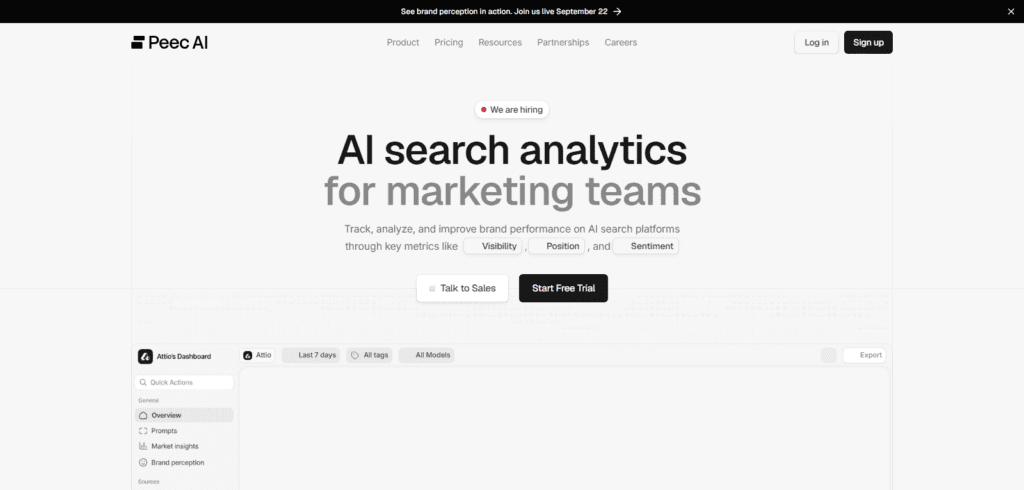
The platform delivers unparalleled insights on how brands are represented throughout the ecosystem empowering teams to adjust their strategies accordingly. Affordable and easy to understand,
Peec AI provides key insights without information overload. Peec AI’s leading performance analytics has established it as a go-to tool to help teams understand how their AI search performance is performing.
Process
- Creates and tracks prompts relevant to a brand or market.
- Measures brand visibility within AI-generated responses.
- Monitors competitor appearances and citations.
- Organizes visibility data by projects and markets.
- Uses the collected data to identify AI-search visibility gaps.
Feature Snapshot
| Feature | Details |
|---|---|
| Founded Year | 2024 |
| Headquarters | Toronto, Canada |
| Pricing | Starts at $1,200/month |
| Core Service | AI search analytics |
| Specialization | Citations, competitor mentions, sentiment |
| Target Users | Small to mid-sized SEO teams |
| Strength | Simple and affordable |
| Limitation | Needs separate SEO execution tools |
| Industry Fit | Analytics-focused SEO teams |
Pros
- Focuses strongly on AI-search visibility analytics.
- Provides prompt-level monitoring.
- Supports competitor visibility research.
- Useful for tracking visibility across projects and markets.
- Provides a relatively focused workflow for marketing teams.
Cons
- Pricing and usage can vary by plan and requirements.
- Some advanced capabilities are reserved for higher tiers.
- Teams managing many projects may need higher-level plans.
- Different AI engines can have different coverage or availability.
- Monitoring insights still require an external SEO/content implementation process.
8. OtterlyAI
OtterlyAI first launched in 2023 and has it’s headquarters in Austin, with an aim of serving small teams and pilot projects. Starting at $500 a month, OtterlyAI is one the the more cost-efficient AI response tracking systems. OtterlyAI has its focus on the tracking of prompts, citations and mentions of competitors across AI based search engines.
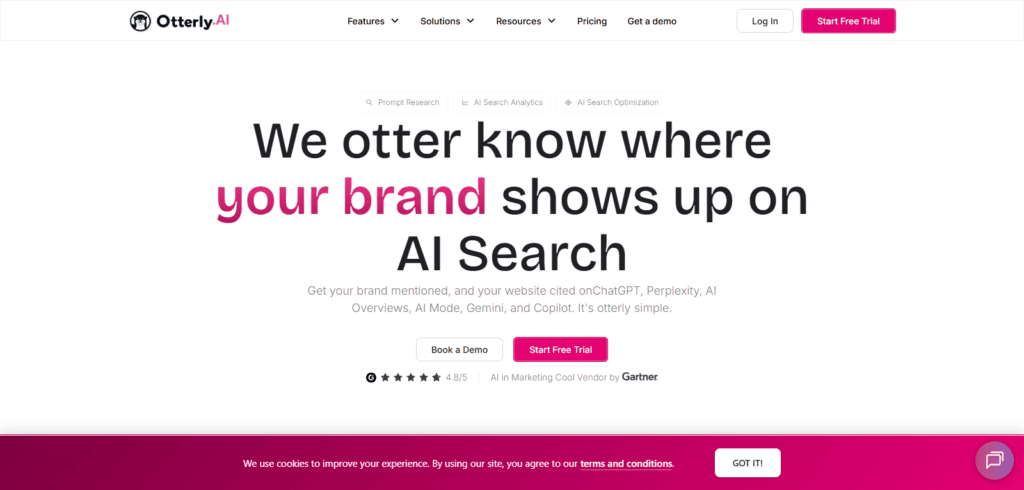
It offers light weight visibility for teams playing around with AI based SEO strategies. OtterlyAI has received some strong consumer reviews on accessibility and usability making it a solid choice for startups and small agencies. OtterlyAI empowers teams to see how their content is represented in AI based responses without the the high costs associated with most enterprise solutions. OtterlyAI excels in offering low cost visibility in the burgeoning field of AI.
Process
- Creates tracked prompts for AI-search monitoring.
- Checks brand and competitor appearances in AI answers.
- Tracks citations and visibility over time.
- Provides sentiment and competitive visibility information.
- Uses recurring monitoring to identify changes in AI-search presence.
Feature Snapshot
| Feature | Details |
|---|---|
| Founded Year | 2023 |
| Headquarters | Austin, USA |
| Pricing | Starts at $500/month |
| Core Service | Lightweight AI answer monitoring |
| Specialization | Prompts, citations, competitor mentions |
| Target Users | Startups, small agencies |
| Strength | Affordable and easy to use |
| Limitation | Light for enterprise governance |
| Industry Fit | Pilot projects, small teams |
Pros
- Focused specifically on AI-search monitoring.
- Supports prompt-level tracking.
- Provides citation and competitor analysis.
- Offers recurring visibility monitoring.
- Suitable for teams that want a dedicated AI-search tracker.
Cons
- Advanced AI-engine coverage may require additional plans or add-ons.
- Monitoring-focused functionality may provide fewer execution features than broader GEO platforms.
- Large prompt inventories can increase usage requirements.
- Teams still need separate workflows for implementing content improvements.
- Higher-level reporting capabilities may require upgrading plans.
9. Brandlight
Starting in 2022, Brandlight has headquarters in Dubai, UAE and operates in worldwide enterprise brand intelligence. At $10,000 a month, Brandlight caters to multi-brand, multi-region visibility. Brandlight identified an area for improvement by monitoring representation of a client’s brand in AI search engines, and providing different insights for different regions and understanding where competitors lie within that region.
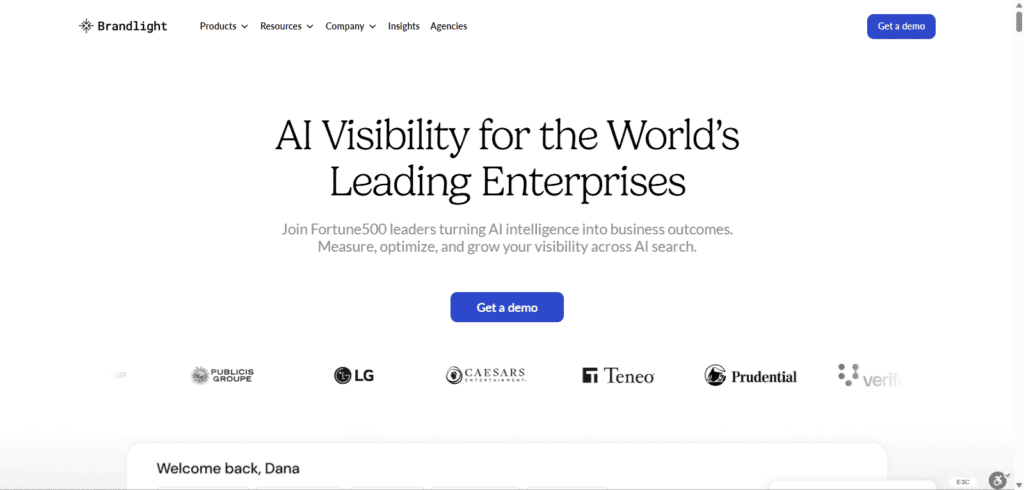
The platform assists global enterprises with governance and compliance to help control AI transparency at a company-wide scale. Due to complexity of multi-region visibility, Brandlight has developed a reputation as a trusted partner for multi-national companies. With an emphasis on global brand intelligence, Brandlight has emerged as a premier company for enterprise AI visibility solutions.
Process
- Monitors how brands appear within AI-generated answers.
- Tracks brand mentions and AI-search visibility.
- Examines competitor presence within relevant answers.
- Uses visibility data to identify areas requiring optimization.
- Helps teams monitor changes in AI-generated brand representation.
Feature Snapshot
| Feature | Details |
|---|---|
| Founded Year | 2022 |
| Headquarters | Dubai, UAE |
| Pricing | Starts at $10,000/month |
| Core Service | Global brand intelligence |
| Specialization | Multi-brand, multi-region visibility |
| Target Users | Multinational corporations |
| Strength | Handles complex visibility challenges |
| Limitation | More than basic SEO use cases |
| Industry Fit | Global enterprise governance |
Pros
- Focuses on AI visibility and brand representation.
- Useful for monitoring brand mentions.
- Can support competitor visibility analysis.
- Helps identify changes in AI-generated brand presence.
- Relevant for teams building an ongoing AI-search monitoring process.
Cons
- Teams may need additional tools for broader traditional SEO analysis.
- Monitoring data requires regular interpretation.
- Advanced requirements may depend on the selected plan.
- Not every team will need extensive brand-monitoring functionality.
- Content execution may require a separate workflow.
10. SE Ranking AI
Founded in 2013, SE Ranking is headquartered in California, USA, and released its AI tracking feature in 2025. Starting at $89 per month, SE Ranking AI aims to offer its features to small businesses and agencies. It provides AI visibility tracking integrated with its existing SEO workflow, thereby analyzing competitor mentions and citations.
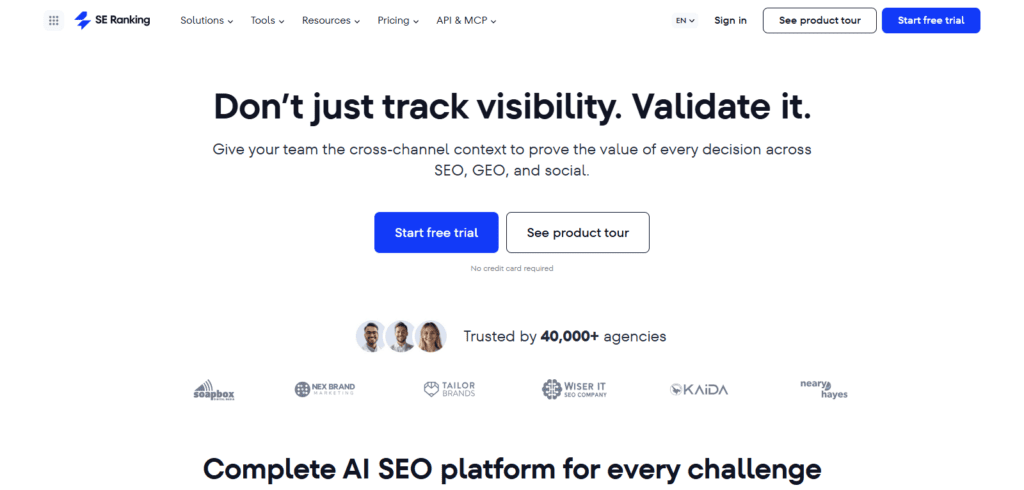
Agencies which manage numerous clients find SE Ranking AI very helpful as it offers scalable reporting and monitoring. SE Ranking AI has been particularly recognized for its affordability and integration, allowing teams to optimize SEO and visibility within the same framework. Expanding its range of offerings, SE Ranking has established itself as a low-cost option for modern SEO practices.
Process
- Tracks brand visibility across AI-search and answer environments.
- Monitors prompts, mentions, competitors, and citations.
- Connects AI visibility data with SE Ranking’s broader SEO workflow.
- Helps identify visibility changes and frequently cited sources.
- Allows SEO teams to combine traditional SEO monitoring with AI-search analysis.
Feature Snapshot
| Feature | Details |
|---|---|
| Founded Year | 2013 (AI module launched 2025) |
| Headquarters | California, USA |
| Pricing | Starts at $89/month |
| Core Service | AI visibility tracking |
| Specialization | Citations + competitor mentions |
| Target Users | Agencies, small businesses |
| Strength | Affordable and integrated |
| Limitation | Less granular than specialist platforms |
| Industry Fit | Agencies managing multiple clients |
Pros
- Combines AI visibility with traditional SEO capabilities.
- Useful for agencies and growing SEO teams.
- Supports prompt and competitor monitoring.
- Provides citation and source insights.
- Can fit AI-search tracking into an existing SEO workflow.
Cons
- Broader SEO functionality may be unnecessary for AI-only monitoring.
- Feature availability varies by plan.
- Teams may need time to configure prompts and tracking.
- AI visibility data still requires human analysis.
- Some advanced requirements may require higher-tier access.
How To Choose AI Answer Tracking Platforms for SEO Teams
Assess AI Search/Answer Engine Coverage– pick platforms that monitor your audience and SEO strategy in AI search/answer engines.
Evaluate Prompt Tracking– check for custom prompts, prompt grouping, tracking frequency, historical data, and adequate prompt limits.
Evaluate Citation Tracking– check if platform identifies cited URLs, domains, citation frequency, and answered AI sources.
Evaluate Brand Mentions– check if platform identifies brand, products, services, and site mentions in AI-based responses.
Evaluate Competitive Analyses– check if platform identifies mentions, visibility parity, citation sources, and opportunities for competing brands answering rather than yours.
Evaluate AI Share of Voice– check if platform evaluates your visibility relative to competitors for relevant prompts and topics.
Review Geographic Coverage– for international SEO, check country, region, language, and market-level tracking.
Review Reporting– review dashboards, reporting frequencies, scheduled reports, and exports for SEO stakeholder reporting.
Consider Seo Tool Integrations– check if the tool integrates with your SEO stack for tools and workflows for rankings, analytics, content, and reporting.
Consider Content Analytics– choose tools that tracks content gaps, most cited sources, missing topics, and content optimization.
Data Accuracy– review results update frequency and if the tool outlines its methods and the limits of its measurements.
Scalability– review the number of domains, prompts, markets, competitors, users, and projects to track.
Compare Pricing and Limits: Look at pricing for prompts, how many credits allowed, how many users, APIs, add-ons, and enterprise packages.
Think About Ease of Use: Choose a product that allows for the easy construction of prompts by SEO teams to analyze the results and eliminate unnecessary data.
Conclusion
AI answer tracking platforms integrate with modern SEO methods because searchers use the Internet beyond search results. The best of these tools enables SEO teams to track mentions, citations, competitors, prompts, visibility, and content in various answer-centric search engines.
Data quality, pricing, scalability, and reporting, as well as AI engine and tracking coverage, are some critical features of the tools. Instead of obsessing over visibility, teams should leverage AI tracking tools to identify cited sources, cite competitors, and urgently needed source content.
AI tracking tools set the goals and metrics frameworks for teams to develop flexible and progressive SEO strategies, as AI search methods and behaviors are bound to continue to change.
FAQ
What are AI answer tracking platforms?
AI answer tracking platforms monitor how brands, websites, products, and competitors appear in AI-generated answers across different AI search and answer engines.
Why do SEO teams need AI answer tracking?
They help SEO teams measure AI visibility, track brand mentions and citations, monitor competitors, and identify content opportunities that traditional keyword tracking may not reveal.
What metrics should SEO teams track?
Important metrics include AI mentions, citation rate, share of voice, prompt visibility, competitor appearances, sentiment, source frequency, and visibility trends.
What is the difference between AI visibility and traditional SEO rankings?
Traditional SEO mainly measures website positions in search results, while AI visibility measures how frequently and prominently a brand or website appears within AI-generated answers.
What is AI citation tracking?
AI citation tracking identifies the websites, pages, and domains that AI-generated answers reference as sources when producing responses.