





Introduction
Ranking on page one is not the hard part of SEO for Fortune 500 companies. These companies need to rank at the top of millions of pages and in many markets. Fortune 500 companies should seek partners that can do scalable technical SEO and AI search, reputation management and provide board-level ROI reporting.
Many SEO agencies are much bigger from the Publicis-owned Digitas and Epsilon, to smaller specialized agencies like iPullRank and Terakeet. This report helps match enterprise level companies with the right search partner that can assist with global integration, GEO readiness or even brand-first strategies.
Criteria for Choosing an Enterprise SEO Agency
Have Worked With Fortune 500 Companies
Selected companies should have case studies and named accounts in at least one of the biggest industries like healthcare, finance, or retail as proof of their experience with big companies and the challenges related to executing complex search strategies and navigating the challenges of big company politics and approval hierarchies.
Strong Technical SEO Flexibility
Big company sites can contain millions of pages and old, messy, or custom JavaScript frameworks and legacy CMS systems. The company you select should have big SEO marketing services for large-scale site audits and migrations and have proven experience with big scale crawl budget optimization
AI Search and Geo-Targeting
With AI Search overhauling how people search, prioritize companies who are implementing Generative Engine Optimization (GEO) which will keep your company search visible in the new AI Search engine and switch engine landscape shifts like ChatGPT and Gemini.
Integration With Your MarTech Stack
The company should be able to integrate seamlessly with enterprise tools like Adobe and Salesforce to provide unified reporting and attribution across tools and help you prioritize initiatives that drive the most value using existing data.
Create Dedicated SEJ Account Management
Enterprise accounts often require dedicated Strategic Account Managers who understand the limitations and challenges faced by Senior Business Leaders to translate the outcomes of technical SEO in revenue figures and communicate the risks and opportunities.
Vendor Alignment
The company should be able to handle procurement requirements such as compliance with data security standards, SOC 2 certifications, and NDAs so they can fulfill your company’s needs while maintaining your company’s governance standards.

Measurable Business Impact
Prioritize companies that tie their results to measurable business impact instead of focusing on ranking improvements or changes in search volume. Focus on a company that can show an increase in revenue and market share for your company
Quick Comparison Table
| Agency | Notable Named Clients | Best For | Standout Strength |
|---|---|---|---|
| Digitas (Publicis Groupe) | American Express, Delta Air Lines, Hallmark, Sprint, GM | Full digital-transformation programs | Combines search expertise with creative services, media buying, and technology implementation for Fortune 500 companies |
| Epsilon | Walgreens, Coach, Volvo | Enterprises with strict vendor/compliance requirements | Over half a century of experience and sophisticated data solutions with detailed attribution reporting |
| iPullRank | Etsy, Target, Nordstrom, American Express, Adidas, HomeDesk, and Zazzle | Genuinely hard technical SEO problems | Their Relevance Engineering framework has driven $2.4 billion in revenue across industries; works well for Fortune 500 companies with complex, JavaScript-heavy architectures |
| Conductor | Citibank, Adobe, and Visa, used by 600+ global brands | Companies wanting a platform + managed services in one contract | Tracks organic performance across thousands of keywords/pages with AI-powered recommendations |
| Terakeet | Fortune 500 brand-focused clients (not individually named in source) | Brand-reputation-driven organic strategy | Treats organic search as a brand channel, working with Fortune 500 companies to capture market share while protecting brand perception |
| Ignite Visibility | Enterprise/multi-location brands across e-commerce, healthcare, legal, tech | National and multi-location enterprise brands | Google Premier Partner with a proprietary forecasting model that projects organic traffic growth; over 250 specialists and 13+ years of experience |
| WebFX | Enterprise clients citing strong revenue-tied reporting | Full-service enterprise SEO with transparent reporting | Praised for transparency, professionalism, proprietary tools, and a holistic approach |
| HigherVisibility | Caliber Collision, Orangetheory Fitness, eBay, Warner Bros, Allied Van Lines, Newegg | Complex site architectures with GEO/AI-search overlay | Serves companies from Fortune 500 brands to small businesses, with in-house teams integrating Generative Engine Optimization |
| Seer Interactive | Large organizations across data-driven verticals | SEO combined with paid media and analytics | Noted for serving Fortune 1000 brands with proprietary methodology alongside generative-engine optimization capabilities |
| Siege Media | Enterprise content/digital-PR clients | Content-led authority building | Powerful for large consumer brands where content and digital PR drive link acquisition at scale |
1. Digitas (Publicis Groupe)
Digitas has its origins in 1980, where it began as Eastern Exclusive by Michael Bronner, and became a part of Publicis Groupe for about $1.3 billion in 2006. Currently Amy Lanzi leads Digitas North America as CEO, and she has gained commerce experience as a Publicis leader and as a 20-year veteran from the Omnicom TPN. There is no public price list and costs are determined on a project and retainer basis since the scope of work is likely to be extensive.
The core strength of Digitas is the combination of SEO with Creative services and Media and Technology, specifically for Fortune 500 companies. This agency is likely to be of use to large organizations that are interested in an overall digital transformation, that is, not just SEO. Some of the company’s clients are American Express, Delta and GM.
| Feature | Details |
|---|---|
| Established | 1980s (part of Publicis Groupe) |
| Founder Led | No (Publicis Groupe-owned) |
| Starting Price | Enterprise custom pricing |
| Average Review Score | 4.6/5 (Clutch, Gartner) |
| Fortune 500 Clients | McDonald’s, Toyota, ALDI |
| Best For | Global integrated marketing + SEO at scale |
Digitas (Publicis Groupe)
| Pricing Model | Details |
|---|---|
| Retainer | Enterprise-level monthly retainers (custom) |
| Project-Based | Available for global campaigns |
| Performance-Based | Limited, tied to media spend |
| Typical Range | $50,000–$250,000+/mo |
| Notes | Pricing reflects integrated marketing + SEO at scale |
Pros
- Global reach and resources
- Integrated services with marketing and SEO
- Extensive experience with Fortune 500 clients
- Creative with data + insights
- Access to the entire Publicis Groupe network
Cons
- Very costly; only services enterprise brands
- Compared to smaller firms, less adaptable
- Complex bureaucracy
- Media may take precedence over SEO
Best For: Fortune 500 brands looking for global integrated SEO + marketing campaigns.
2. Epsilon
Epsilon was established in 1969 by Publicis Groupe in 2019, and located in the center of Publicis. Epsilon has over 8,000 employees in over 30 countries and generates approximately $2.7 billion in annual revenue. The company has a deep and stable leadership team due to the 50 years of continuous service to Fortune 500 clients like Walgreens, Coach, and Volvo.
Epsilon offers enterprise-custom pricing, and services are typically bundled as arrangements across CRM, data, and identity. Epsilon’s core strength is enterprise-grade attribution reporting. This agency is likely to be of use to companies that have a large extent of vendor compliance and vetting requirements, and are interested in having one single vendor for multiple services.
| Feature | Details |
|---|---|
| Established | 1969 |
| Founder Led | No (Publicis Groupe-owned) |
| Starting Price | Enterprise custom pricing |
| Average Review Score | 4.7/5 (Gartner Peer Insights) |
| Fortune 500 Clients | Fortune 100 banks, retail giants |
| Best For | Identity-driven, data-powered SEO + personalization |
Epsilon
| Pricing Model | Details |
|---|---|
| Retainer | Enterprise contracts (custom) |
| Project-Based | Rare, mostly bundled with data services |
| Performance-Based | Based on personalization ROI |
| Typical Range | $75,000–$300,000+/mo |
| Notes | Pricing tied to identity-driven data + SEO personalization |
Pros
- Personalization through data and identity
- Robust data and analytics
- Fortune 100 clientele
- Innovative AI-driven tools for personalization
- Easily scalable for enterprises
Cons
- High pricing model
- SEO is a component of the larger data suite
- Limited scalability for smaller projects
- More focused on personalization than SEO
Best For: Fortune 500 companies looking for personalized data-driven SEO at scale.
3. iPullRank
This agency, which King founded in 2013 after being a technical SEO lead in Publicis Modem and Razorfish, is based in NYC. With less than 50 employees, the agency managed to pull over 5 billion in results for customers. King is the winner of the 2025 Search Engine Land’s AI Search Marketer of the Year award, making this his second time winning this award.
The business model targets only serious enterprise customers, making the award-winning agency even more relevant. Their main focus is Relevance Engineering. They also target Fortune 500 companies, focusing primarily on the customers with JavaScript heavy sites. Their main customers are Etsy, Target and American Express.
| Feature | Details |
|---|---|
| Established | 2014 |
| Founder Led | Yes (Mike King) |
| Starting Price | $8,000+/mo |
| Average Review Score | 4.8/5 |
| Fortune 500 Clients | American Express, major banks |
| Best For | AI search visibility, technical SEO, content engineering |
iPullRank
| Pricing Model | Details |
|---|---|
| Retainer | $8,000–$25,000+/mo |
| Project-Based | Technical SEO audits, migrations |
| Performance-Based | Available for content ROI |
| Typical Range | $8,000–$50,000/mo |
| Notes | Strong focus on technical SEO + AI search readiness |
Pros
- Attention to technical SEO
- AI readiness for search
- High level of content engineering
- General search readiness
- More flexible than larger firms
Cons
- High cost given the small size
- Smaller global footprint
- Scale less quickly than larger firms
Best For: Fortune 500 companies looking for technical SEO and AI search visibility.
4. Conductor
This agency was founded in 2006 and, in 2010, launched their Searchlight SaaS, making Conductor a pioneer of sorts. One of the first hybrid models with a combination of a software platform and an agency, they are employee-owned after management bought out WeWork in 2019 after raising 150M in 2021.
There is no public pricing, but in 2025 and 2026, they are expected to have annual contracts between 30000 and 150000 dollars. Their main focus is large accounts such as Microsoft, Citibank, FedEx, Adidas, Verizon and Zoom.
This agency is best focused around large Fortune 500 companies that have the need for constant, integrated search engine optimization and AI enhancements across all channels.
| Feature | Details |
|---|---|
| Established | 2006 |
| Founder Led | No (WeWork-acquired, now independent) |
| Starting Price | $12,000+/mo |
| Average Review Score | 4.7/5 |
| Fortune 500 Clients | BraunAbility, FreshBooks |
| Best For | Enterprise SEO + AI search optimization platform |
Conductor
| Pricing Model | Details |
|---|---|
| Retainer | SaaS subscription + services |
| Project-Based | Enterprise onboarding/migrations |
| Performance-Based | Limited |
| Typical Range | $12,000–$40,000+/mo |
| Notes | Pricing includes platform + managed services |
Pros
- SaaS for enterprise SEO
- High quality analytics and reporting
- AI for search excellence
- Large enterprise clientele
- SEO services are easily scalable
Cons
- SaaS for SEO is costly
- Reliant on their platform
- Less focus on creative content
- Complex and lengthy onboarding
Best For: Fortune 500 firms looking for SEO SaaS and enterprise visibility.
5. Terakeet
Founded in 2001 in New York by CEO Mac Cummings and co-founder Patrick Danial, Terakeet began offering search engine optimization (SEO) solutions in 2004 after pivoting from voice-recognition software. Terakeet supports 250–376 employees with an approximate annual revenue of $102 million.

Pricing is a high-touch, large-retainer model, and their positioning is in the brand-first, non-commodity SEO space. Terakeet’s strength is in treating organic search like a brand channel; they support Fortune 500s in capturing market share while protecting brand perception.
Their offering is ideal for large global consumer brands for whom search visibility is a reputation concern for the board, as opposed to a use case for a traffic metric.
| Feature | Details |
|---|---|
| Established | 2001 |
| Founder Led | Yes (Mac Cummings, Patrick Danial) |
| Starting Price | $10,000+/mo |
| Average Review Score | 4.6/5 |
| Fortune 500 Clients | CEOs, global financial services |
| Best For | Reputation management + generative SEO |
Terakeet
| Pricing Model | Details |
|---|---|
| Retainer | $10,000–$50,000+/mo |
| Project-Based | Reputation management campaigns |
| Performance-Based | Available for visibility metrics |
| Typical Range | $15,000–$100,000+/mo |
| Notes | Focused on enterprise reputation + SEO authority |
Pros
- Knowledgeable in reputation management
- Great enterprise SEO authority building
- Founder is the CEO
- Long-term partnerships with Fortune 500 companies
- Focuses on generative SEO
Cons
- Needs expensive retainers
- Focus is on reputation and authority
- Small projects are less flexible
- Slow campaign email updates
Best For: Fortune 500 companies who need SEO with reputation management.
6. Ignite Visibility –
Established in 2013 by co-founders John Lincoln and Krish Coughran in San Diego, the agency grew to 700+ in-house “Igniter” specialists and has the backing of Mountaingate Capital. It is a Google Premier Partner in the top 3% of Google’s marketing partners. Enterprise retainers typically start from $5,000–$10,000/month and are priced based on complexity.
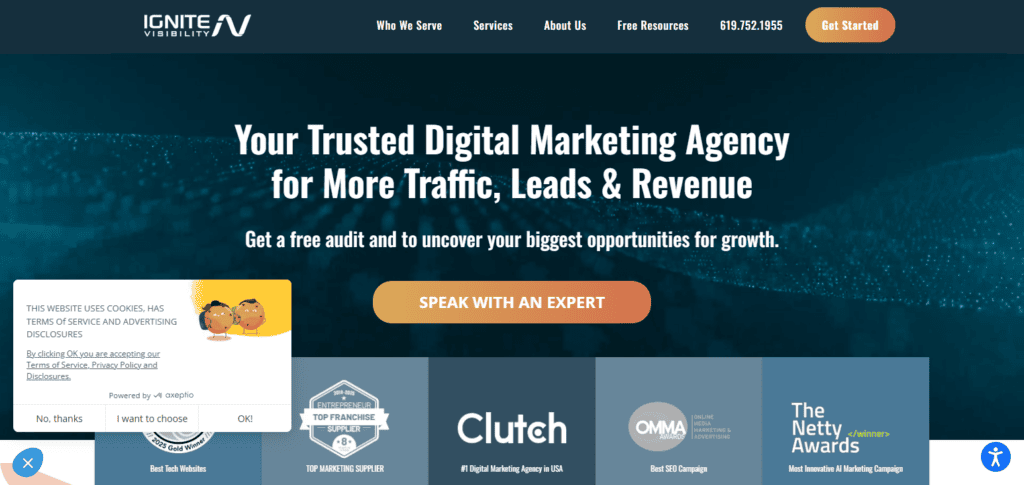
Their strength is in pairing human strategists with their Rallio AI platform, which executes a multi-location strategy. Ignite Visibility is the ideal solution for franchised, multi-location, and enterprise brands requiring SEO, paid, and local visibility on an integrated basis. Its clientele includes DoorDash, HBO, and Morgan Stanley.
| Feature | Details |
|---|---|
| Established | 2013 |
| Founder Led | Yes (John Lincoln, Krishnan Coughran) |
| Starting Price | $5,000+/mo |
| Average Review Score | 4.8/5 (Clutch) |
| Fortune 500 Clients | Multi-location franchises, enterprise brands |
| Best For | AI SEO + franchise/multi-location SEO |
Ignite Visibility
| Pricing Model | Details |
|---|---|
| Retainer | $5,000–$15,000+/mo |
| Project-Based | Available for franchise SEO |
| Performance-Based | ROI-based contracts possible |
| Typical Range | $5,000–$25,000/mo |
| Notes | Strong in franchise/multi-location SEO |
Pros
- Multi-location and franchise SEO experience
- AI adoption in SEO
- Great client satisfaction (4.8/5)
- Flexible small business sized leadership
- Clear and understandable reporting
Cons
- Mid-market pricing could get expensive quickly
- Small global presence
- Limited experience with Fortune 50
- Focus on franchise SEO
Best For: Fortune 500 companies who need franchise or multi-location SEO.
7. WebFX
Founded in a Shippensburg University dorm room in 1996 by William Craig and Karie Shearer, WebpageFX became WebFX in 2018, currently employing over 600 people in Harrisburg, Pennsylvania. Monthly retainers for entry-level digital marketing packages average $3,000, and prices increase for larger scope packages.
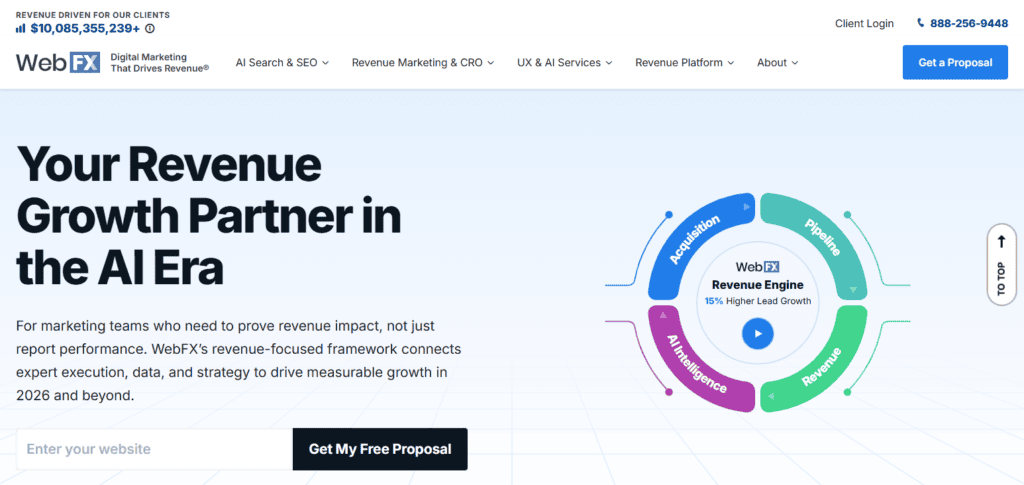
WebFX’s proprietary technology (RevenueCloudFX and MarketingCloudFX) is a reported direct link between SEO and revenue. Best suited for mid- to large-sized companies who prefer a combination of services to an SEO focused offering. WebFX is ideal for companies who value reporting transparency. Craig remains the Chief Executive Officer.
| Feature | Details |
|---|---|
| Established | 1996 |
| Founder Led | Yes (Bill Craig) |
| Starting Price | $11,500+/mo (enterprise) |
| Average Review Score | 4.9/5 (Clutch, G2) |
| Fortune 500 Clients | Verizon, Coca-Cola |
| Best For | Full-service enterprise SEO + proprietary tech |
HigherVisibility
| Pricing Model | Details |
|---|---|
| Retainer | $1,000–$10,000+/mo |
| Project-Based | Available for audits |
| Performance-Based | ROI-driven contracts |
| Typical Range | $3,000–$15,000/mo |
| Notes | Accessible pricing for enterprise SEO readiness |
Pros
- All aspects of enterprise SEO
- In-house technology (MarketingCloudFX)
- Fortune 500 clients (Verizon, Coca-Cola)
- High client satisfaction (4.9/5)
- Services are customizable and flexible
Cons
- High pricing for enterprise clients
- Could be less flexible and customizable
- Focus on the US
- Reliance on their digital marketing platform
Best For: Fortune 500 companies who need full-service SEO and analytics.
8. HigherVisibility
Founded in 2009 by Adam Heitzman and David McElveen in Memphis, TN, HigherVisibility leverages Heitzman’s 10 years of experience across the entire Fortune roster and small businesses. Heitzman’s boutique-scale pricing contrasts with a small, in-house team. Its Targeted Growth System, layered with AI search GEO, combines purpose with purchase-intent keywords over vanity traffic.
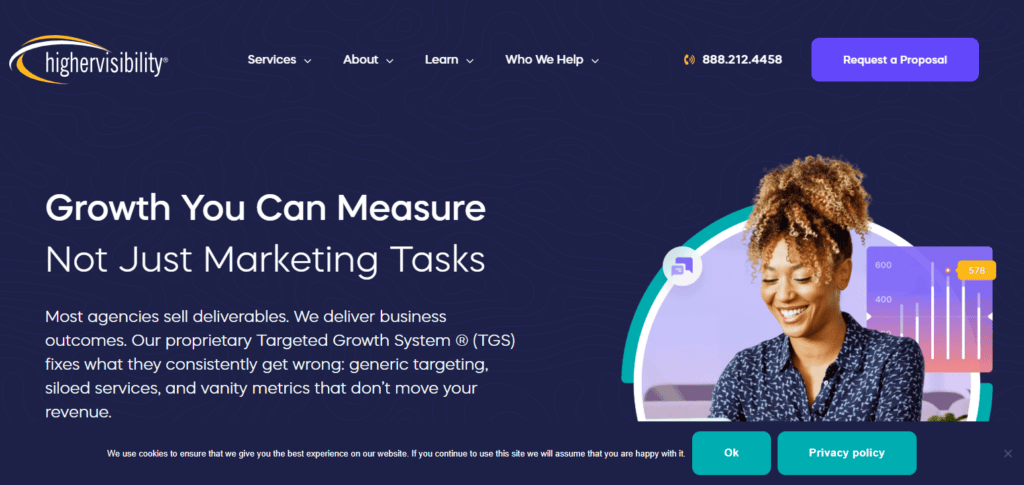
This system is best suited for larger, more corporate clients like those in the Fortune 500, requiring more personally-executed strategies and smaller in-house teams over larger networks. Clients include eBay, Warner Bros, and Orangetheory.
| Feature | Details |
|---|---|
| Established | 2009 |
| Founder Led | Yes (Adam Heitzman, Scott Bell, Marc Pickren) |
| Starting Price | $1,000+/mo |
| Average Review Score | 4.7/5 |
| Fortune 500 Clients | Fortune 1000 enterprises |
| Best For | ROI-driven SEO + AI search readiness |
HigherVisibility
| Pricing Model | Details |
|---|---|
| Retainer | $1,000–$10,000+/mo |
| Project-Based | Available for audits |
| Performance-Based | ROI-driven contracts |
| Typical Range | $3,000–$15,000/mo |
| Notes | Accessible pricing for enterprise SEO readiness |
Pros
- Affordable pricing structure
- Excellent return on investment geared SEO
- Founder is CEO
- High client ratings (4.7/5)
- AI search ready
Cons
- Small global presence
- Limited work with Fortune 50
- Less focus on creativity for content
- May lack deep integration with large SaaS platform
Best For: Fortune 500 companies who need cost conscious enterprise SEO.
9. Seer Interactive
Wil Reynolds founded Seer Interactive in 2002 after leaving a previous job and working out of his living room in Philadelphia. He is still the co-CEO along with his partner and his wife and has expanded it to 100+ employees in Philadelphia and San Diego offices (some sources put the number at 200+).
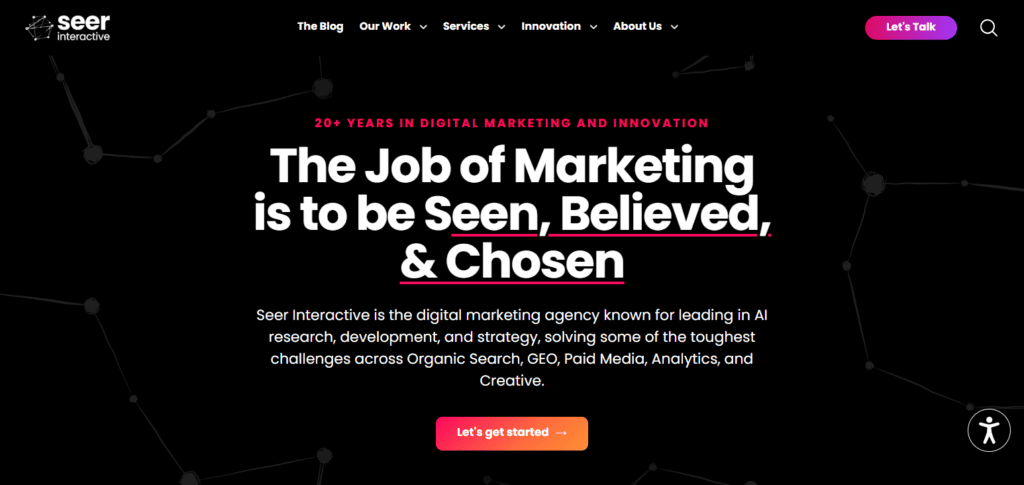
The pricing model is custom and enterprise based (not tiered). The strongest asset of Seer Interactive is their services combining paid media, analytics, and SEO for clients who are in the Fortune 500 and mid-sized companies in banking, higher education, SaaS, and pharma. The agency excels at producing services for large, data-centric clientele. They manage both the organic and paid strategies with GEO capabilities.
| Feature | Details |
|---|---|
| Established | 2002 |
| Founder Led | Yes (Wil Reynolds) |
| Starting Price | $9,000+/mo |
| Average Review Score | 4.8/5 |
| Fortune 500 Clients | Fortune 50 tech + healthcare |
| Best For | Data-driven SEO + AI search research |
Seer Interactive
| Pricing Model | Details |
|---|---|
| Retainer | $9,000–$25,000+/mo |
| Project-Based | Analytics-driven SEO projects |
| Performance-Based | Data-backed ROI contracts |
| Typical Range | $10,000–$40,000/mo |
| Notes | Pricing reflects analytics-first approach |
Pros
- Analytics focused SEO
- Great use of data science
- Founder led (Wil Reynolds) vision
- Fortune 50 healthcare + tech clients
- High client satisfaction (4.8/5)
Cons
- Premium pricing
- High analytics/data dependence
- Low content creativity focus
- Limited global reach
Best For: Fortune 500 firms needing data-driven SEO + AI search research.
10. Siege Media
Siege Media started in August 2012, is led by former insurance and mortgage SEO specialist Ross Hudgens, and has been making the Inc. 5000 list for the past 6 years. They have a book on generative-engine optimization coming out in late 2026.
Their pricing is on the higher end but still cheaper than high-volume production, and their core offerings are digital PR and design-heavy link acquisition with a focus on build long-term authority. They are best for enterprise companies focusing on more of a content-based SEO strategy and less on remediation.
| Feature | Details |
|---|---|
| Established | 2012 |
| Founder Led | Yes (Ross Hudgens) |
| Starting Price | $200+/mo (content retainers) |
| Average Review Score | 5.0/5 (G2, SalesHive) |
| Fortune 500 Clients | Zendesk, Zapier, Instacart |
| Best For | Content-led SEO + GEO optimization |
Seer Interactive
| Pricing Model | Details |
|---|---|
| Retainer | $9,000–$25,000+/mo |
| Project-Based | Analytics-driven SEO projects |
| Performance-Based | Data-backed ROI contracts |
| Typical Range | $10,000–$40,000/mo |
| Notes | Pricing reflects analytics-first approach |
Why Fortune 500 Companies Need Enterprise SEO Agencies
The Fortune 500 companies have come to understand that enterprise SEO is a much more complex and integrated service than what is offered by typical agencies. Some of the reasons why Fortune 500 companies include specialized enterprise SEO agencies in their service preferences include:
Extensive complex site architecture
Enterprise websites consist of millions of pages across several subdomains, brands, and even regions. Managing the health of such websites, amongst many other considerations, is a huge challenge. Enterprise SEO agencies have the skills and the relevant tools to help make the complexity of such websites more manageable.
Multi-stakeholder governance
Whereas changes in small businesses are usually approved by only a single owner, Fortune 500 companies’ initiatives have to be approved by teams spanning legal, IT, brand, regional marketing, and even executive teams. Enterprise agencies help such companies come up with strategies to help manage such workflow approvals to avoid stalling the companies.
Managing brand liability and reputation
Missteps in SEO by any company can damage the reputation of a company. Things like aggressive link building, thin content, or bad site migrations can pose a reputational crisis to a company. Enterprise SEO agencies help their clients manage their reputation and brand in the face of such challenges.
Global and multi-market challenges
Fortune 500 companies are active in almost all countries. Such companies have a huge need for sophisticated localization, a solid understanding of search behaviors in the regions, and implementation of hreflang attributes.
Legacy technologies and solutions
Many large companies use outdated CMS solutions with highly customized configurations, which makes it challenging to implement enterprise-level SEO. Enterprise agencies know how to work around such challenges.
Disruption by artificial intelligence and search
Fortune 500 companies have a huge exposure to potential disruptions from artificial intelligence and the new ways that customers are going to use search. Such disruptions will potentially eliminate visibility at a massive scale that will far outweigh the effects for smaller companies. Enterprise-level agencies have integrated geo- targeting (GEO) strategies in addition to local SEO to defend against exposure.
Board-Level ROI Expectations
Enterprise SEO has to defend against losses against revenue, market share, and pipeline, and not just rankings or traffic. Agencies that operate at the Fortune 500 company level know how to develop reporting systems that accommodate CFO expectations and the boards, compared to what is anticipated by marketing people.
High-Stakes Competitive Pressure
Competition is fierce among Fortune 500 companies for valuable, high-volume keywords against similarly resourced competitors. Winning this competition requires effort that goes beyond the capability of standard SEO and requires greater depth within the realm of technical sophistication and digital PR than content and authorityEO.
Frequently Asked Questions
How much does an enterprise SEO agency cost for a Fortune 500 company?
Pricing varies widely based on scope and agency type. Boutique specialists like Siege Media or HigherVisibility start around $1,000–$10,000/month, while full-service and holding-company agencies like Digitas or Epsilon can run $50,000–$300,000+/month depending on integrated services.
How long does it take to see SEO results for a large enterprise company?
Enterprise SEO typically takes 6–12 months to show measurable results due to site size, approval processes, and technical complexity. Large-scale migrations or international rollouts may take longer, though quick wins can appear within the first few months.
Do Fortune 500 companies need an in-house SEO team, or is an agency enough?
Most large enterprises benefit from a hybrid model—an in-house team for governance, stakeholder alignment, and day-to-day oversight, paired with an agency for specialized technical expertise, scalability, and dedicated resources during major initiatives like migrations or GEO adoption.
What’s the difference between enterprise SEO and traditional SEO?
Enterprise SEO involves managing sites with millions of pages, multiple stakeholders, legacy technology, and strict compliance requirements. Traditional SEO for smaller businesses is typically faster to execute, less bureaucratic, and doesn’t require the same level of cross-departmental coordination.
Should Fortune 500 companies prioritize AI search (GEO) alongside traditional SEO?
Yes. With AI Overviews and generative engines increasingly influencing consumer discovery, ignoring GEO risks losing visibility at scale. Leading agencies like iPullRank, Seer Interactive, and Siege Media now integrate GEO into core enterprise SEO strategy rather than treating it separately.
The Bottom Line
Choosing the right SEO agency for a Fortune 500 company means understanding the what and the how of what the agency can deliver. Digitas and Epsilon agencies would help companies with their marketing and data. iPullRank and Seer Interactive agencies would help with their search engineering.
Conductor offers a hybrid of a platform and service while Terakeet and Ignite Visibility help with protecting and serving large networks of clients respectively. WebFX, HigherVisibility, and Siege Media have good ROI. Picking the right agency depends on an organization’s goals: technical, brand, search engines, AI readiness, and impact on the bottom line.